Installation view of "Mushroom Clouds," PHD Group, Hong Kong, 2026. Courtesy the artists and PHD Group. Photo by Felix SC Wong.
ZHENG MAHLER: MUSHROOM CLOUDS
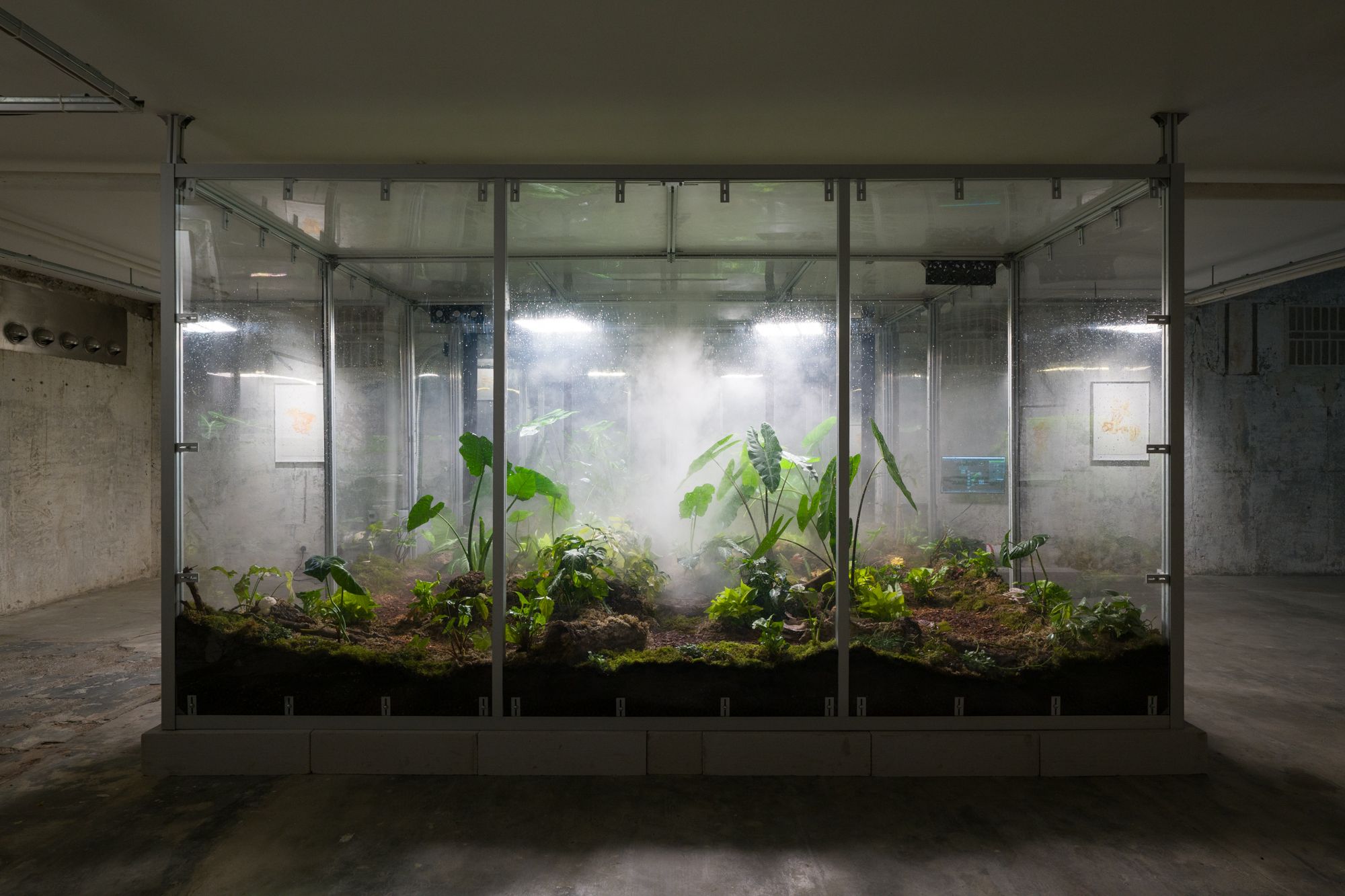
Installation view of "Mushroom Clouds," PHD Group, Hong Kong, 2026. Courtesy the artists and PHD Group. Photo by Felix SC Wong.
What is it like to live, sense, and feel as a mushroom? To begin to dissect this question, we must first approach the idea of consciousness and understand that to truly embody the mind of another species is to confront, and challenge, our human-centric biases.
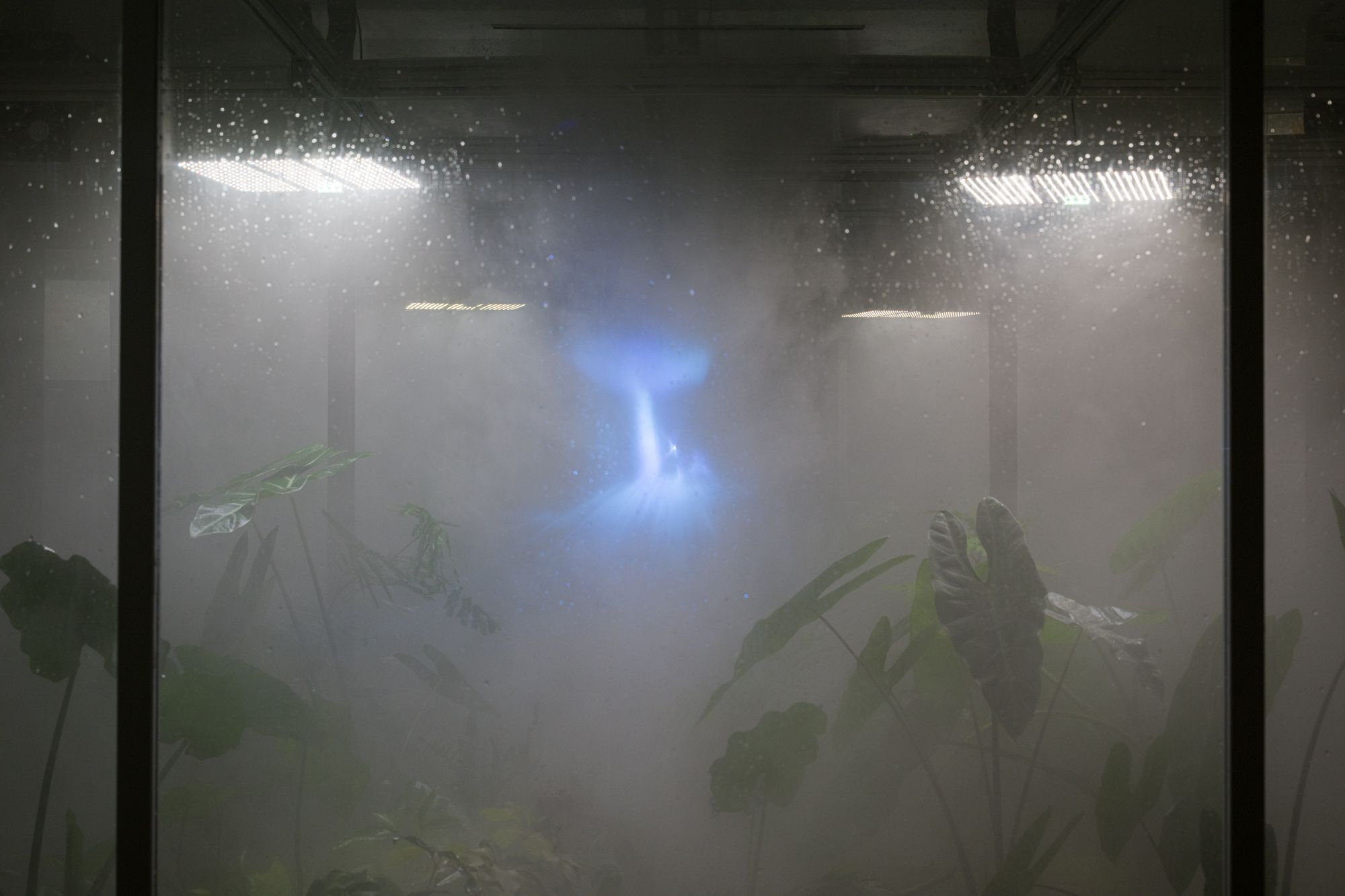
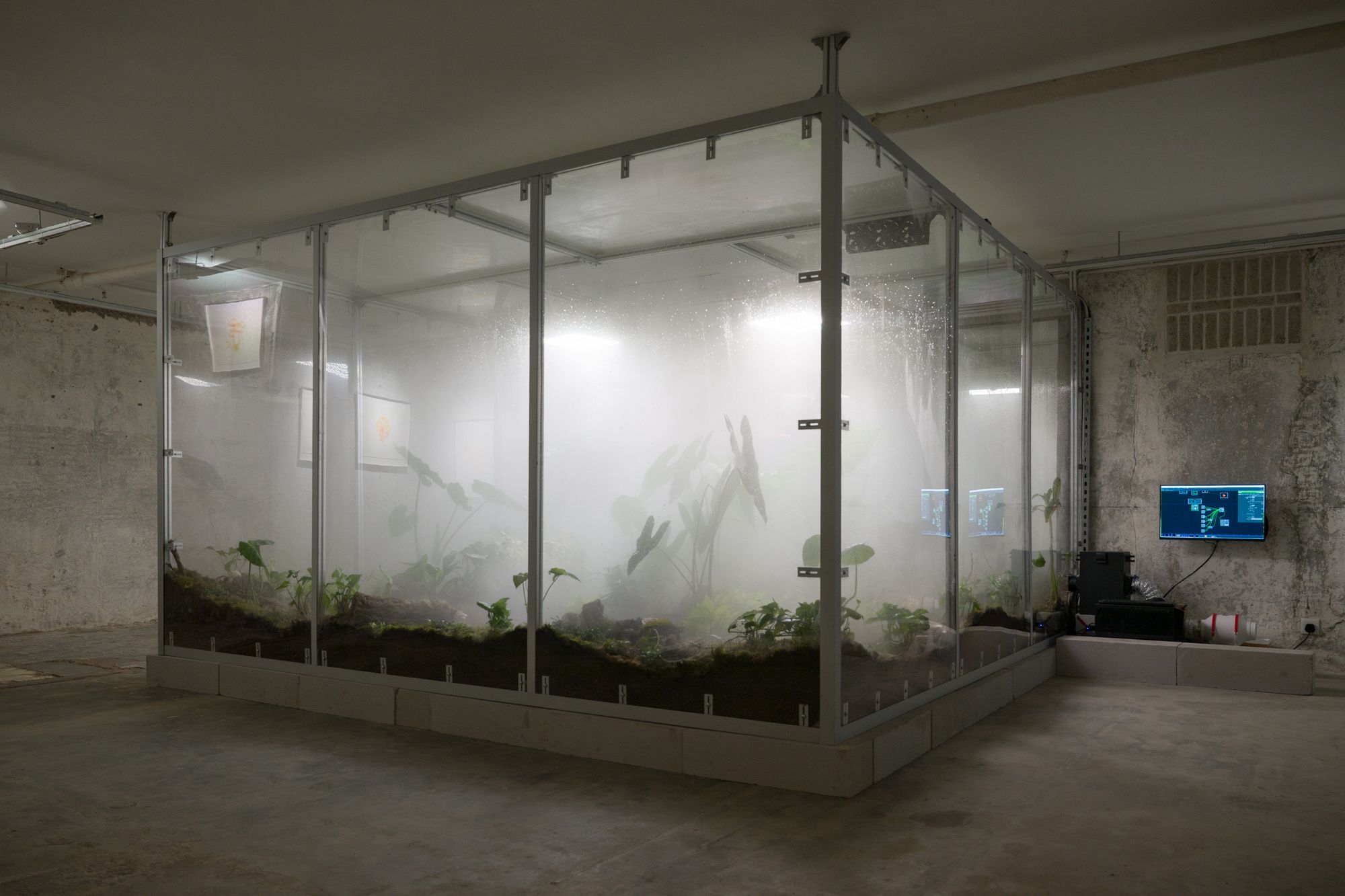
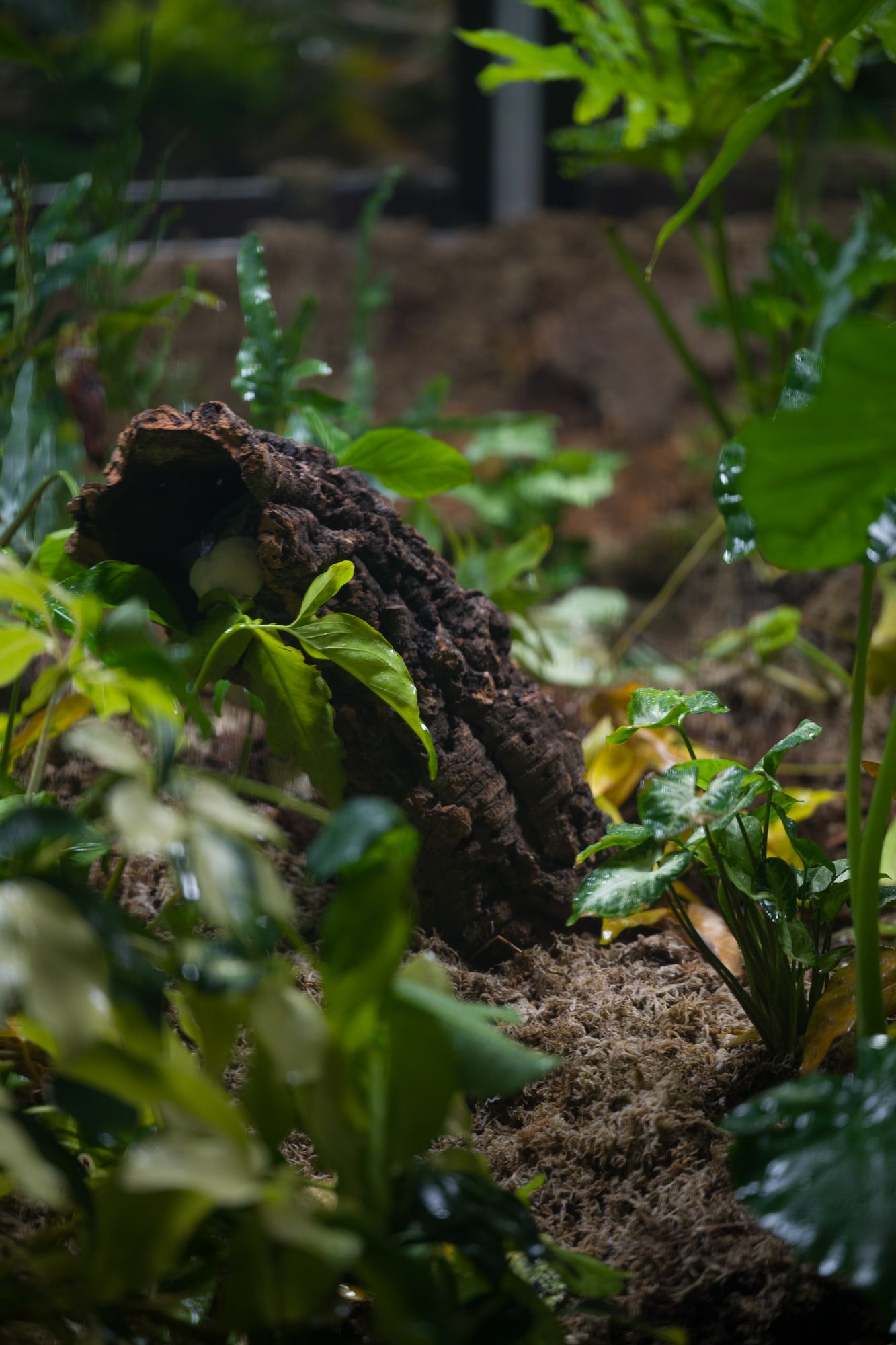
For their second solo show at PHD Group, “Mushroom Clouds,” Zheng Mahler present a large-scale living, breathing, vivarium informed by the biodiverse ecosystems on Lantau Island. Built with the help of local myco-tech specialist Steven Yuen, the vivarium is a living example of the generative, collaborative, and responsive networks of our natural world: nestled between the shaded foliage of elephant ears and wispy tendrils of mimosa pudica are living fungi, playfully sprouting and retreating from logs and moss throughout the duration of the exhibition.
These interactions, often spontaneous and unpredictable, are the culmination of Zheng Mahler’s long-term research into fungi. Initiated by a curiosity around AI’s dearth of knowledge around fungi species—a cursory input for mushrooms, as an example, generated only button and portobello varieties—the duo began by examining the relationship between technology’s human-centric perspectives and the Western world’s mycophobia, or “fear of fungi,” and its cultural correlation with death or madness.
This line of research led, ultimately, to the query at the heart of Zheng Mahler’s project: what if artificial intelligence could be trained to think, feel, and generate more expansively, empathetic and sensitive to the consciousness of other beings beyond humans?
To begin this process, Zheng Mahler conducted extensive research on their local home island of Lantau and encountered thirty-eight distinct species of mushrooms during one seasonal foray. After photographing and compiling their findings, they produced a unique dataset and fed it into a custom AI model to generate new, speculative mushroom species, from the perspective of other mushrooms.
The idea that fungi are sentient, even conscious, is one that fascinates and haunts our collective social mindset. Beneath the soil lie mycelial networks that can be described as highly intelligent, capable of exchanging nutrients with plant roots and transmitting chemical signals to warn of pests and diseases. Similarly, conversations around artificial intelligence possessing a sentient hive mind complicates our feelings toward technological advancements. This tension can be found in the titular definition of “clouds.” A cloud is a visible formation of water droplets, a tangible element to invisible systems of cooling and vaporizing. Similarly, we tend to only encounter the “clouds” of fungi, the colorful ruffles and heads, while entire responsive mycorrhizal networks (known colloquially as the "wood wide web”) exist underground beyond our sight. A “cloud” is also the commonplace term we use for data storage, in particular with relation to cloud-based artificial intelligence systems, which can process volumes of information in seconds. The extreme anxiety and fear around these dense systems triggers a socio-historical memory of another type of cloud: the ominous miasmas of ash and smoke that occur after nuclear explosions, signaling an event horizon that has also come to define artificial intelligence.
The relationship between fungi and AI—two culturally misunderstood systems, one natural, one technological—comes together in Zheng Mahler’s vivarium, where a dense fog occasionally appears above the plants and fungi. Projected onto this “cloud” is a real-time response video of AI-hallucinated mushrooms, creating a ghostly display of Lantau fungi. This mingling of the tangible and intangible, the real and imaginary, at once expands our beliefs around consciousness and taps into our fear of the unknown.
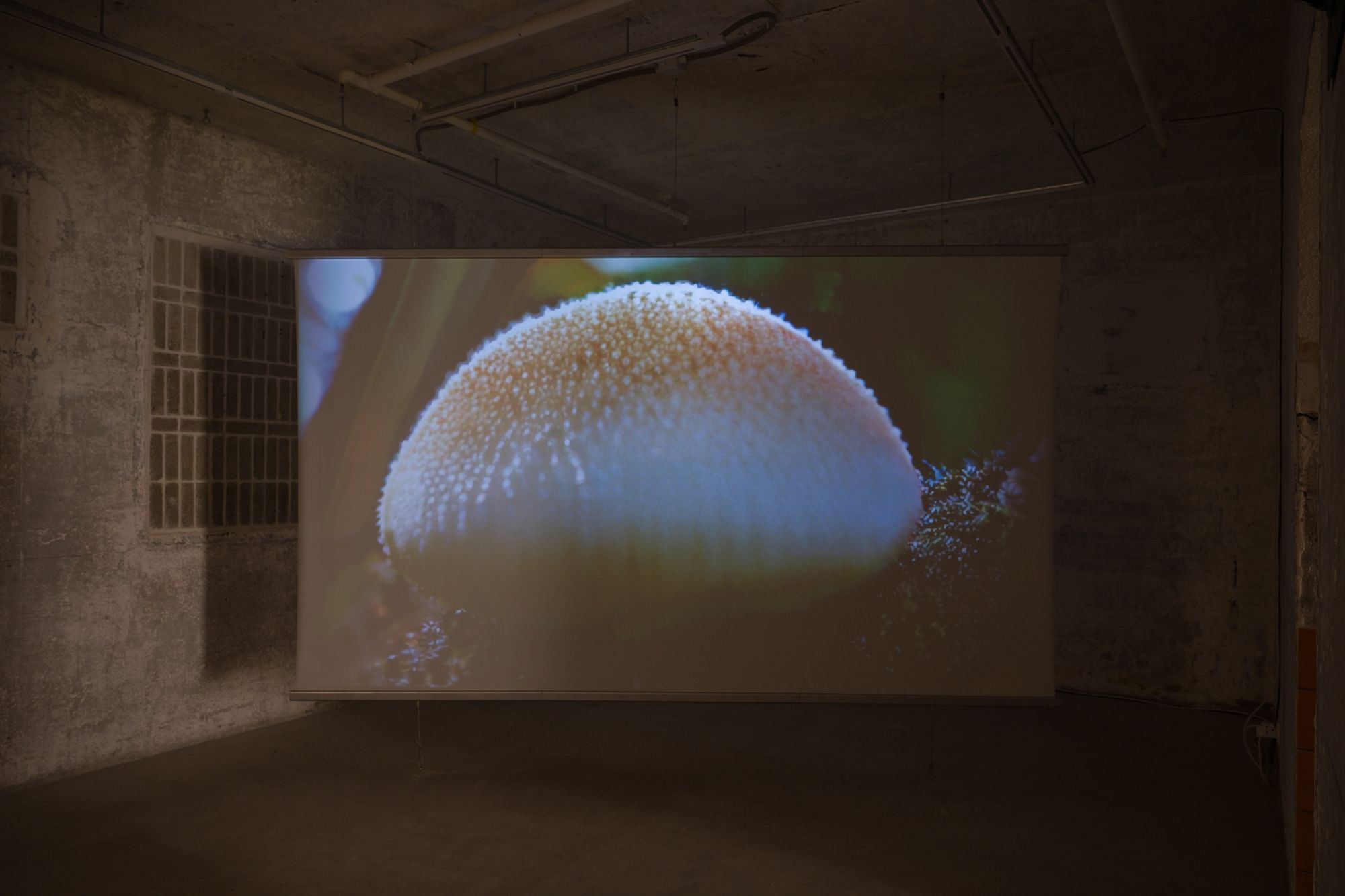
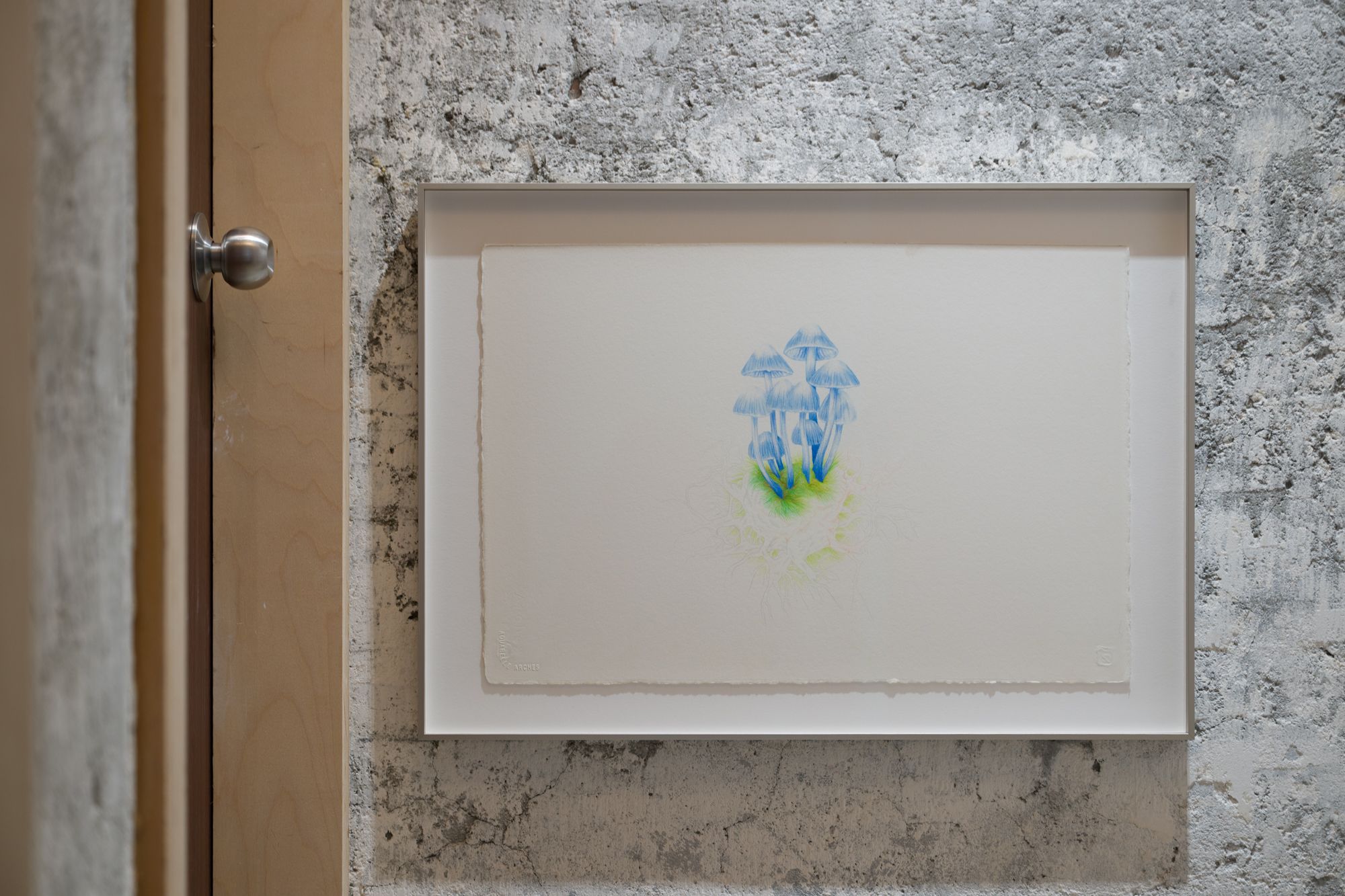
To complete the exhibition, a series of drawings of a number of fungi species found on Lantau and used in the AI dataset appears around the gallery space for visitors to encounter, loosely referencing the spontaneous joy of a foraging experience. An expanded screening video of a new digital project "The Twenty-Three Thousand Sexes of Schizophyllum Commune and Other Stories," is screened continuously alongside the vivarium, with a musical composition by longtime collaborator John Bartley. Originally commissioned by M+ museum, the digital project features Zheng Mahler’s research into fungi as fed into a custom AI model, supplemented with animation prompts that evoke the pulsing, energetic sequences of traditional 16mm film, in particular the work of artist Len Lye and filmmaker Stan Brakhage.
Envisioned as chapters, each mushroom’s video and descriptive text (found online at lantaufungi.world) is presented as a story of care and wonder, subverting the typical taxonomic descriptions of fungi with relation to their poison or parasitic categorization. The titular schizophyllum commune, as an example, is described on Wikipedia as an “an opportunistic environmental pathogen,” whereas in Zheng Mahler’s project, the fungi’s narrative is given a more empathetic approach. Written from the perspective of the inclusive “they/them” pronoun, the project indicates the vast and complex spectrum of this one species: “Twenty-three thousand ways of being all at once and none at all.”
Responding to the highly collaborative, playful, and curious nature of life around us, “Mushroom Clouds” and “The Twenty-Three Thousand Sexes of Schizophyllum Commune and Other Stories” completes Zheng Mahler's Lantau trilogy work, capturing their years-long research into the ontology of their more-than-human neighbours; water buffaloes, bats, and finally, fungi.
Deepest thanks and gratitude to Kate Gu, Associate Curator for Digital Special Projects, M+ Hong Kong, for the web commission invitation; John Bartley, musician and composer, for sound compositions and production; Steven Yuen, Founder and CEO of myconoko, for fungi and terrarium consultancy, supply and cultivation support; Michele Piazzi, theatrical set and lighting designer, for designing the customised volumetric fog display system; Dr Alvin Ming-chak Tang, mycologist, for his generous assistance in fungi identification and consultancy; and Russell Kong, founder of Urban Mushroom, for generously supplying the lingzi.
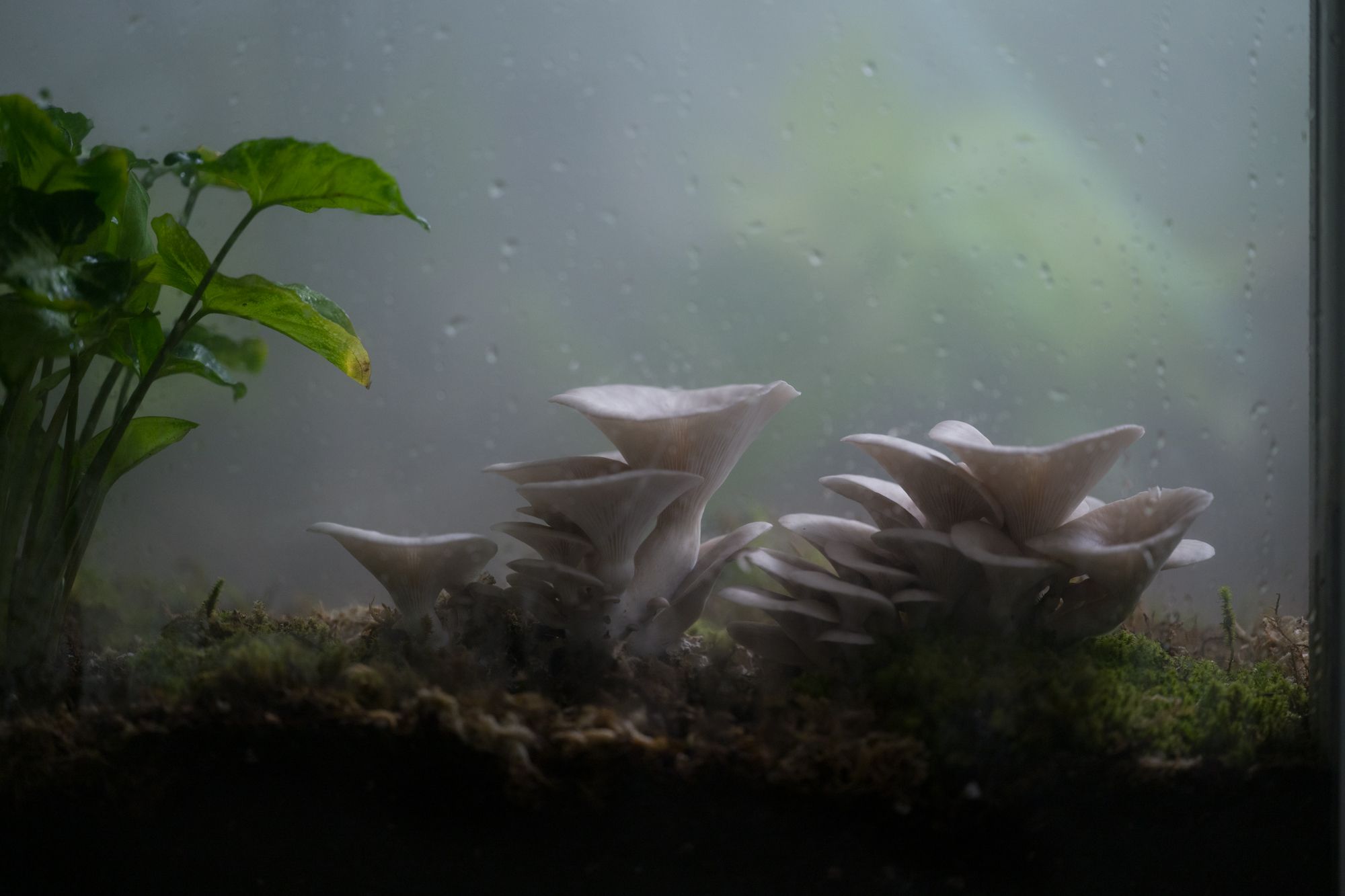
Installation view of "Mushroom Clouds," PHD Group, Hong Kong, 2026. Courtesy the artists and PHD Group. Photo by Felix SC Wong.
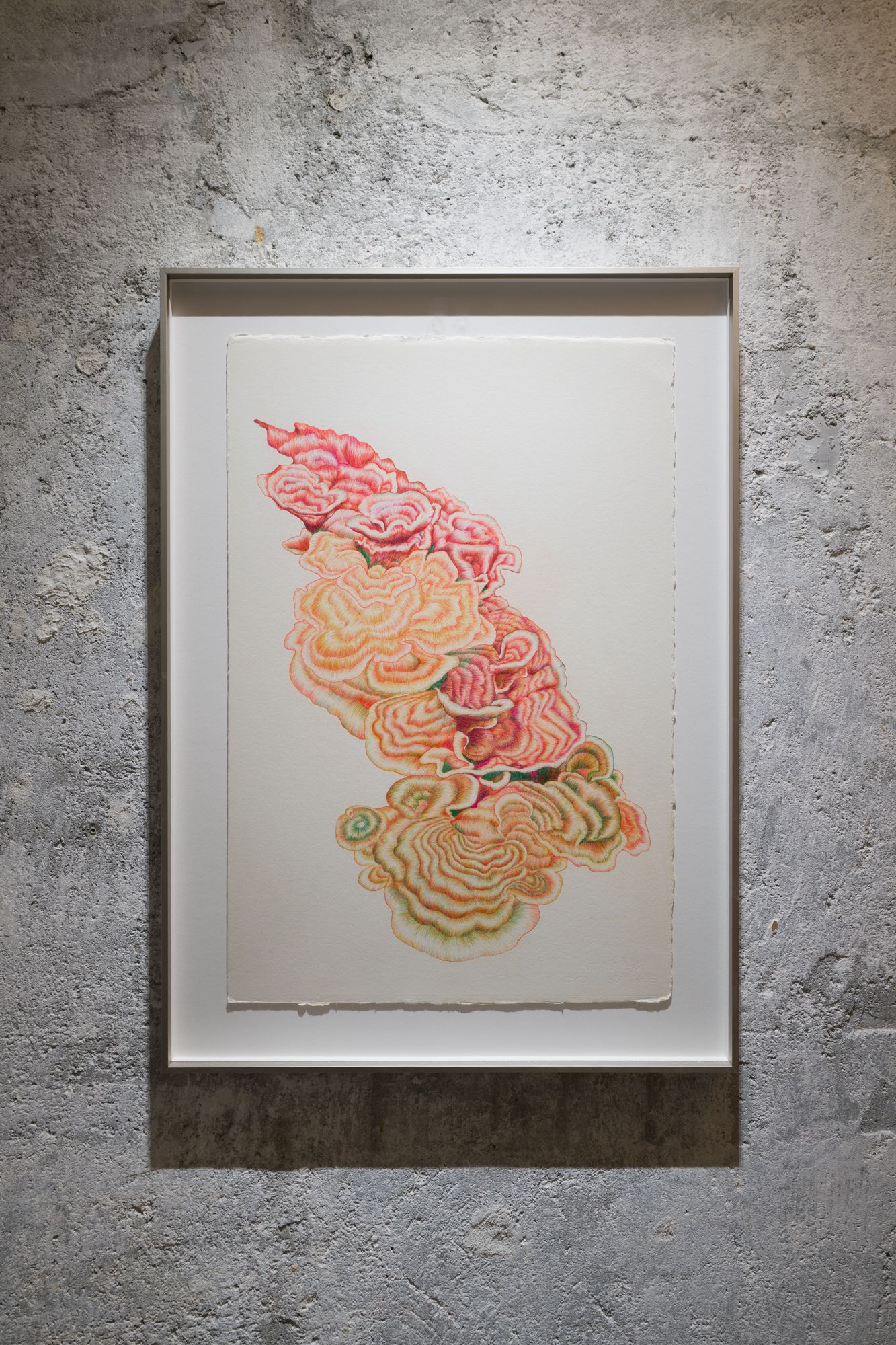
Zheng Mahler
Fungi of Fortune and Misfortune-Ganoderma tropicalis
2026
Coloured pencil on paper
58 x 38.5 cm
Installation view of "Mushroom Clouds," PHD Group, Hong Kong, 2026. Courtesy the artists and PHD Group. Photo by Felix SC Wong.
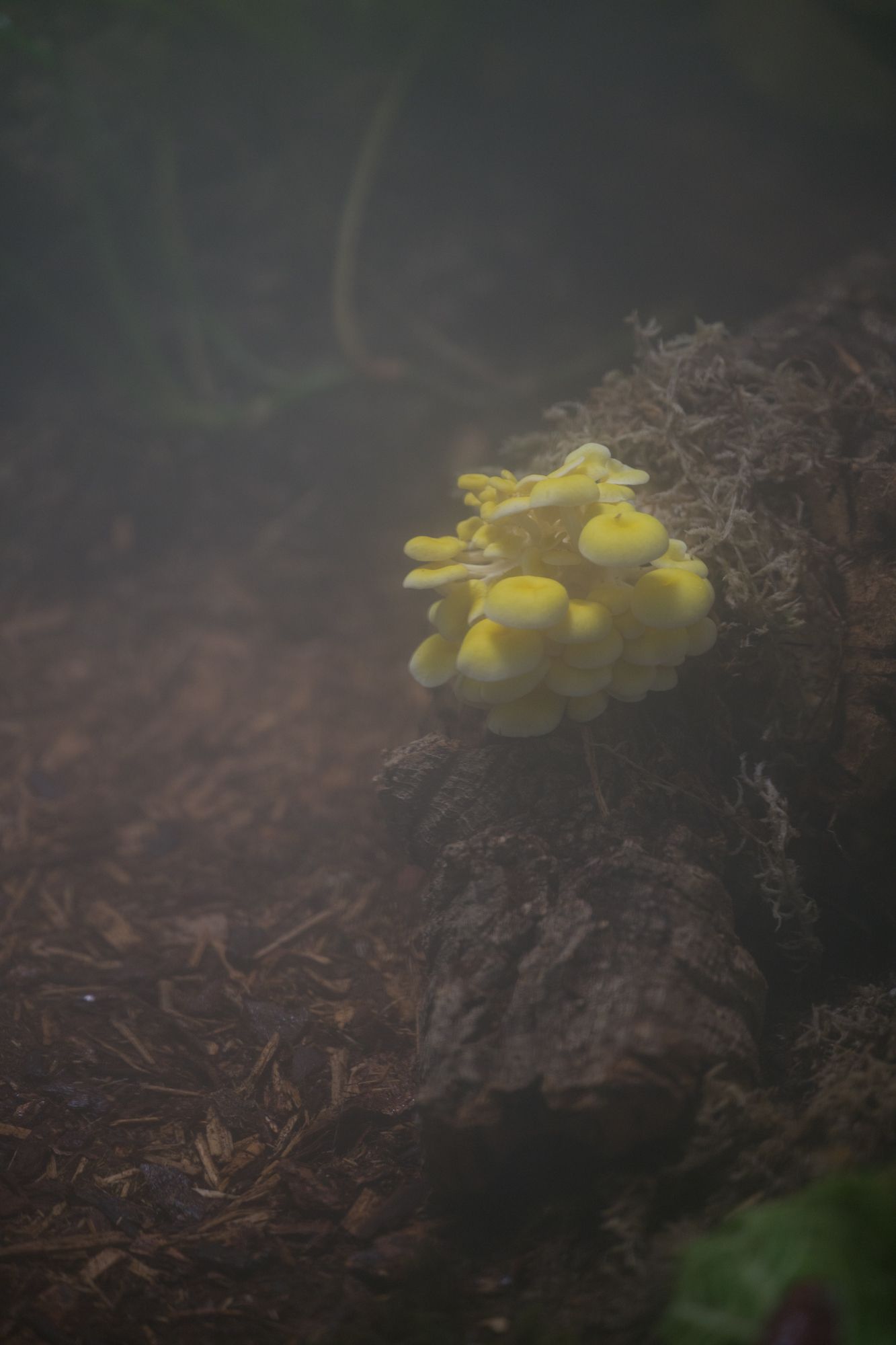
Installation view of "Mushroom Clouds," PHD Group, Hong Kong, 2026. Courtesy the artists and PHD Group. Photo by Felix SC Wong.
Zheng Mahler
The Twenty-Three Thousand Sexes of Schizophyllum
Commune and Other Stories
2026
AI-generated video with color and sound: 23 min 37 sec
Installation view of "Mushroom Clouds," PHD Group, Hong Kong, 2026. Courtesy the artists and PHD Group. Photo by Felix SC Wong.
Zheng Mahler
The Blue Mushrooms of Tai Tung Shan-Inocephalus virescens
2026
Coloured pencil on paper
28.5 x 58 cm

Installation view of "Mushroom Clouds," PHD Group, Hong Kong, 2026. Courtesy the artists and PHD Group. Photo by Felix SC Wong.
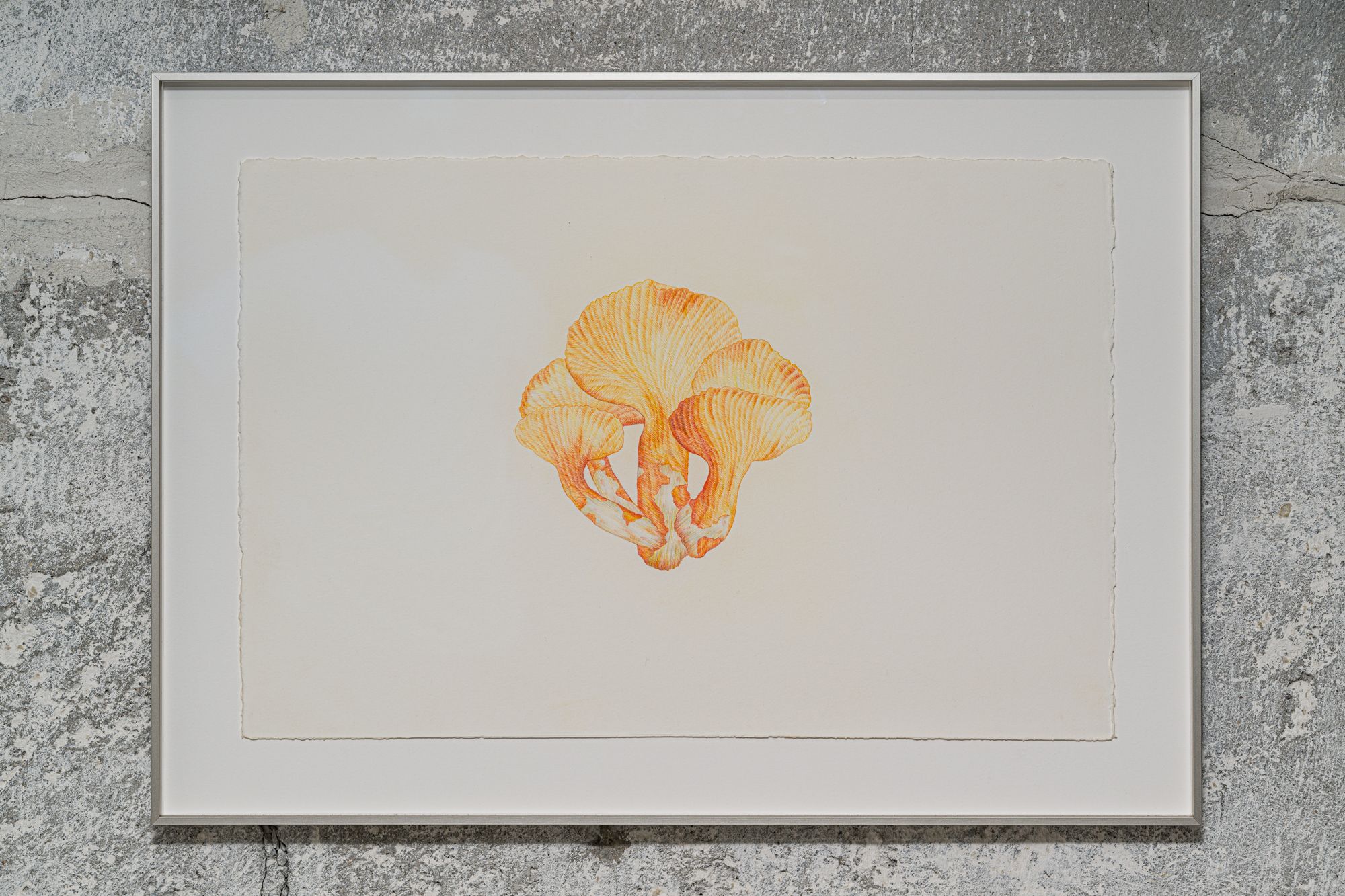
Zheng Mahler
Tiny Cleaners Who Dance in the Rain-Marasmius epiphyluus
2026
Colored pencil on paper
38.5 x 58 cm
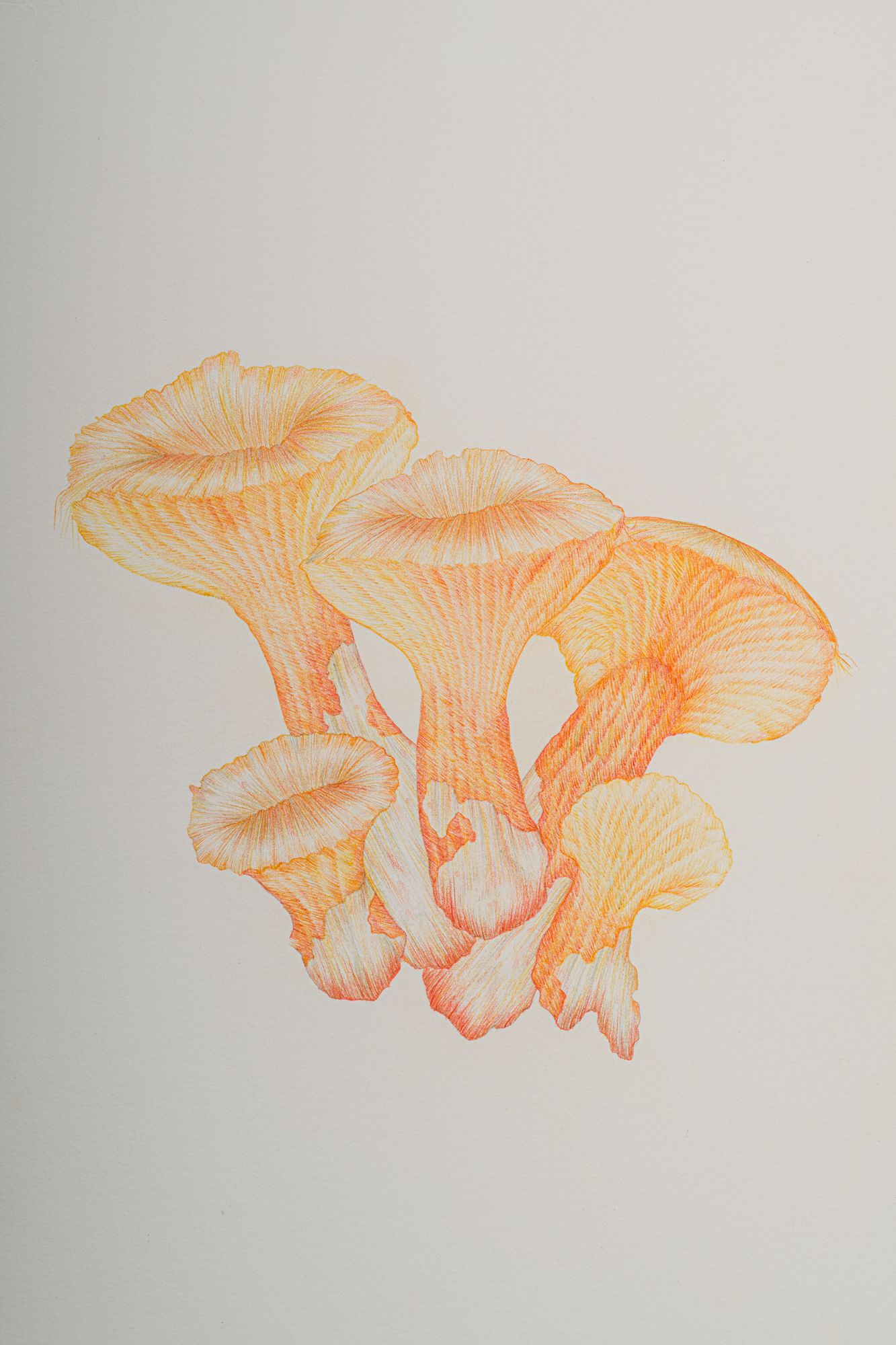
Zheng Mahler
The Pure Voiced Mushroom-Amanita odessus
2026
Colored pencil on paper
58 x 38.5 cm
Installation view of "Mushroom Clouds," PHD Group, Hong Kong, 2026. Courtesy the artists and PHD Group. Photo by Felix SC Wong.
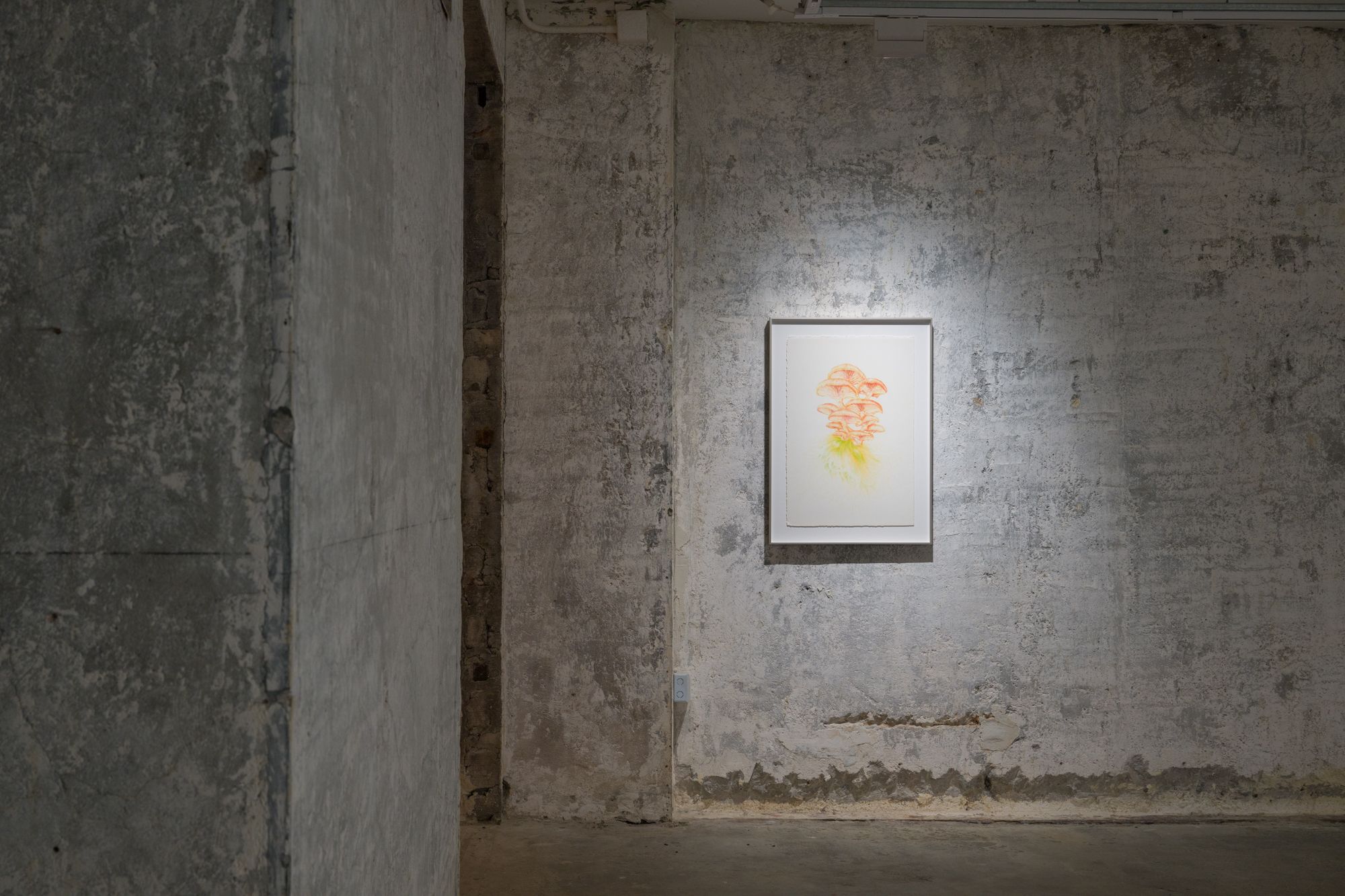
Zheng Mahler
A Mischievous Mushroom-Gymnopilus aeruginosus
2026
Colored pencil on paper
58 x 38.5 cm
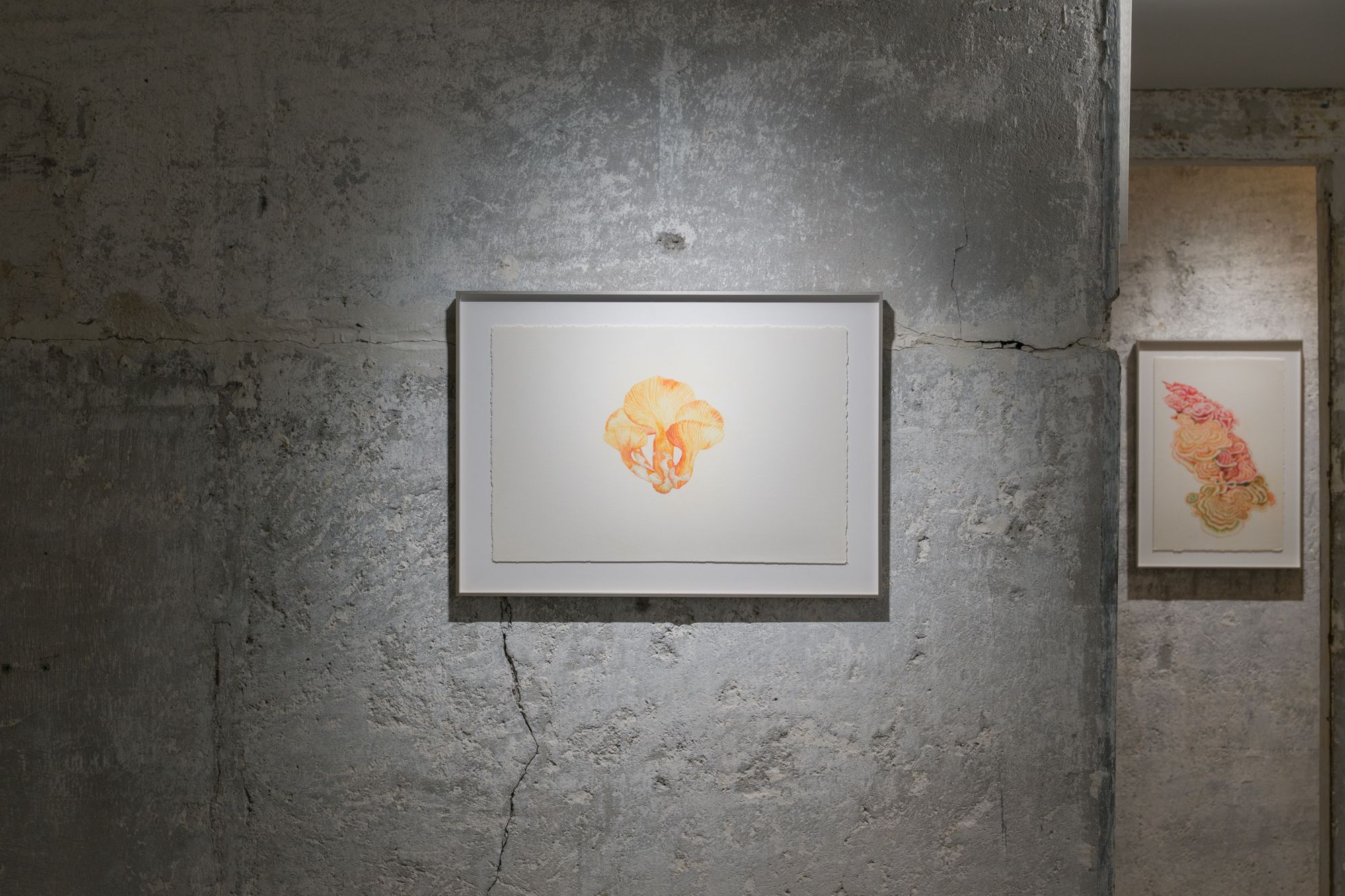
Installation view of "Mushroom Clouds," PHD Group, Hong Kong, 2026. Courtesy the artists and PHD Group. Photo by Felix SC Wong.