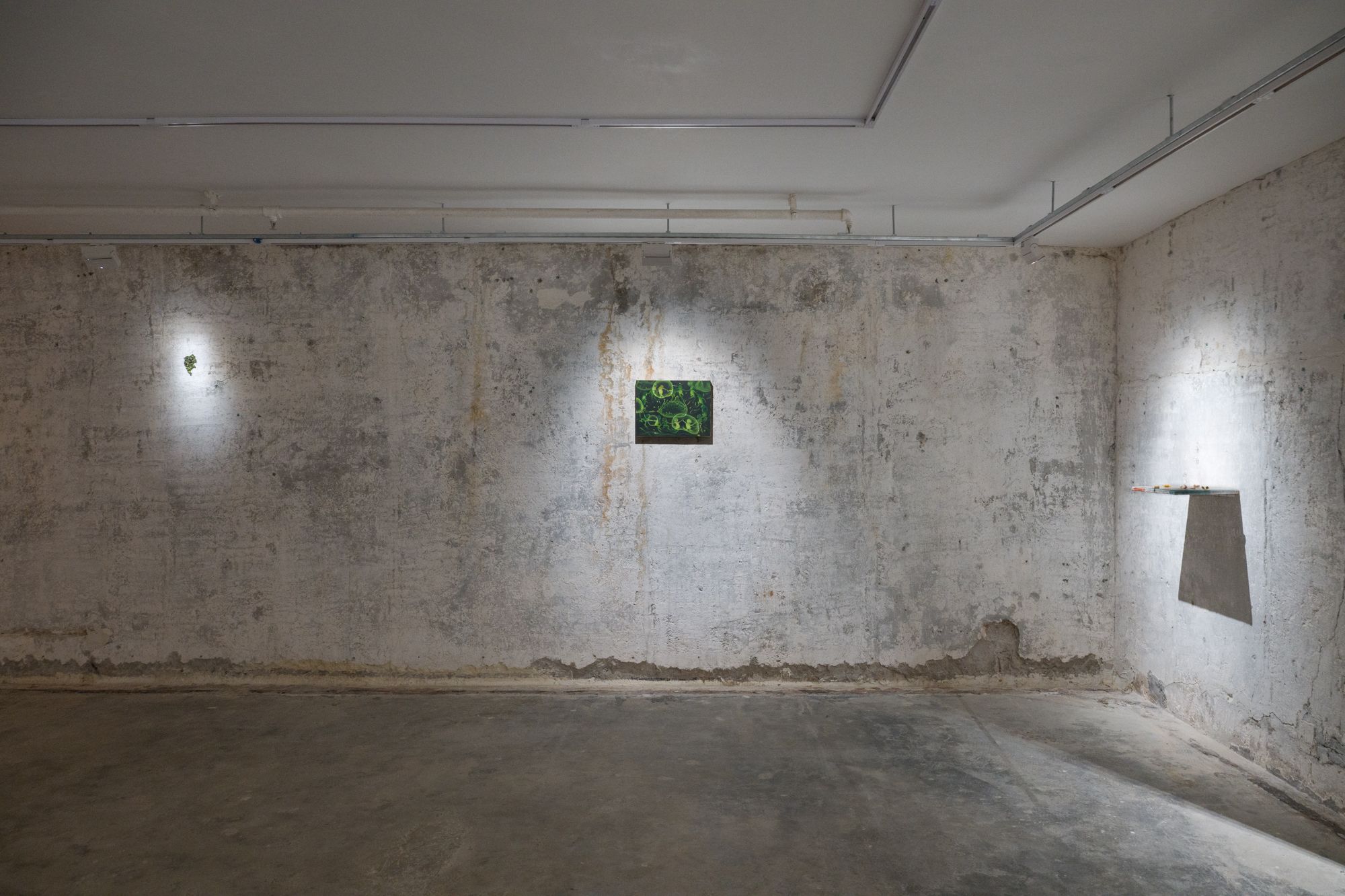
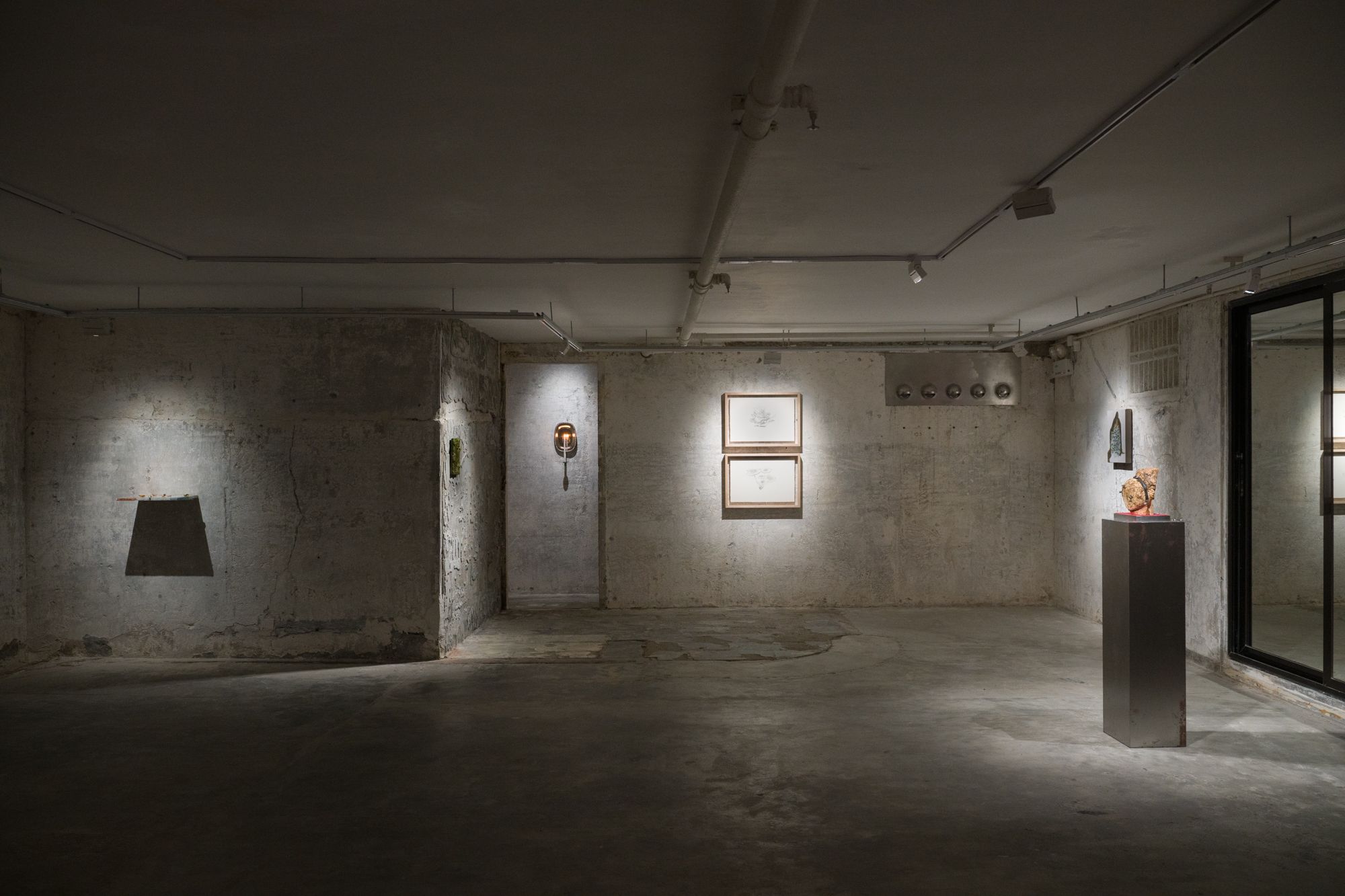
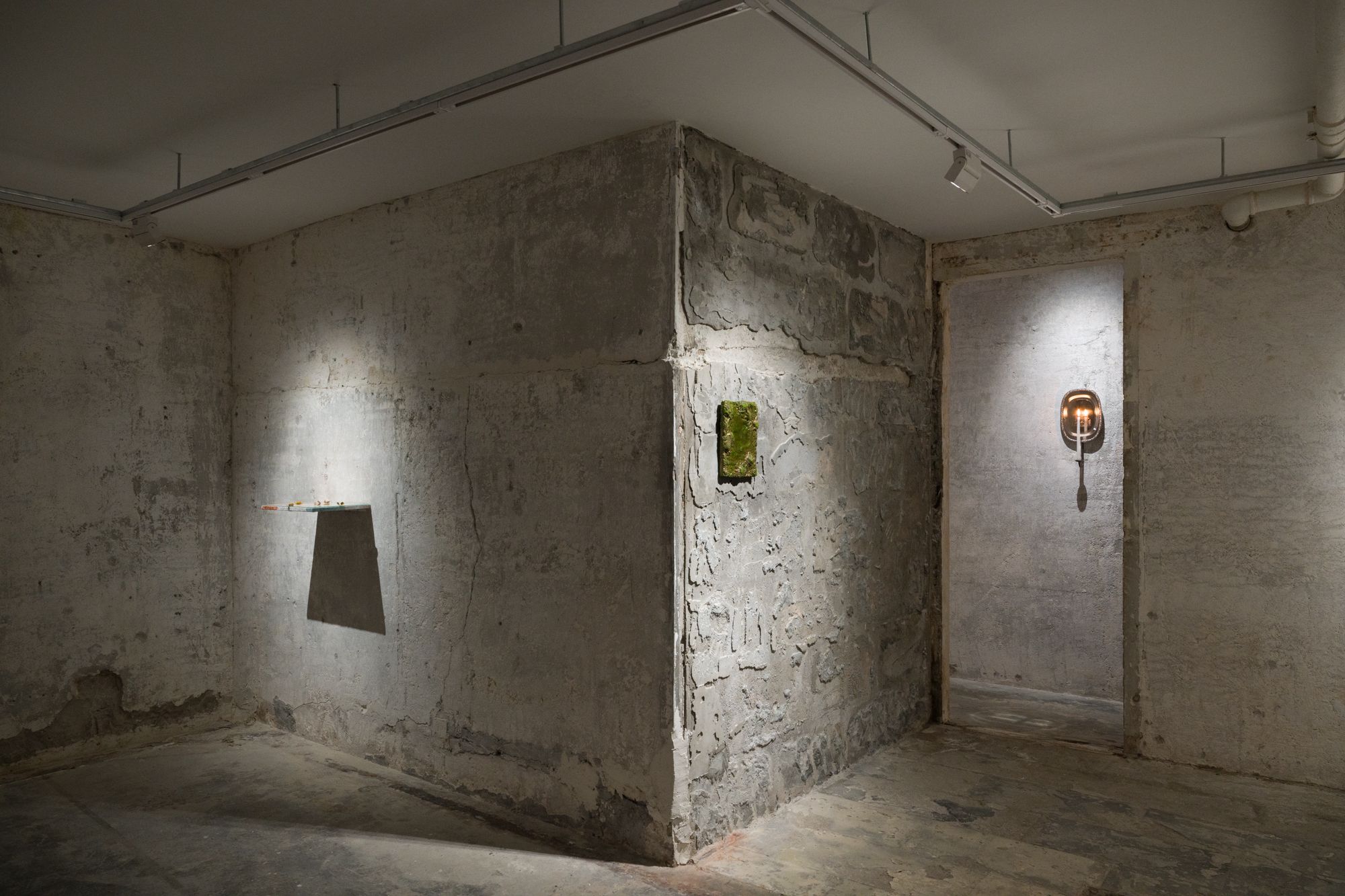
Installation view of "Mothering" at PHD Group, 2025. Photo by Felix SC Wong.
MOTHERING
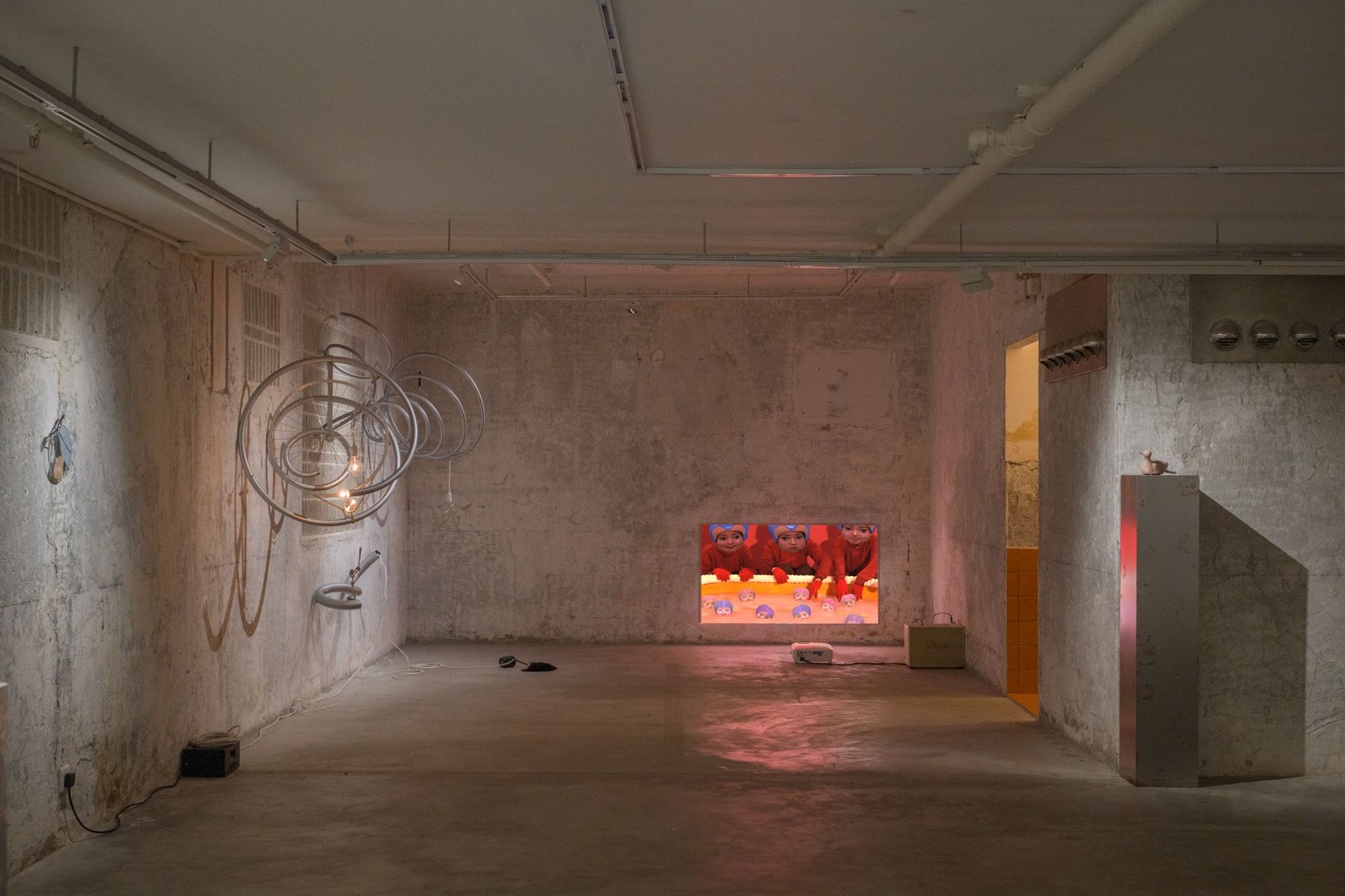
Installation view of "Mothering" at PHD Group, 2025. Photo by Felix SC Wong.
Chan Ting, Michele Chu, Liao Wen, Yuko Mohri, Sasaoka Yuriko, Tan Jing, Pam Virada, Wang Xu, Xi Jiu, and Zheng Mahler
At first, we tried to kill them, these spindly fingers of green and bruised purple. Emerging from the raw concrete and creeping over the pipes and railings, they took hold of the gallery’s exterior rooftop space, untouched by typhoons and droughts. For how long they had been there, we didn’t know—but we saw how fast they grew, and we were afraid.
They were surprisingly easy to uproot, requiring nothing more than a sharp tug that revealed shallow roots attached to a pile of dust. One summer, we spent hours inspecting every crevice of the rooftop, mechanically erasing any trace of these plants. But the next month, they all grew back.
We looked up the species: mother of thousands. We learned that the plant propagates vegetatively by growing plantlets on its leaf margins, the offspring developing tiny roots before falling off onto the ground. Exhausted by their desire to survive, we let them be, allowing them to grow along the walls and in our plant pots.
Two years ago, not long after our last group exhibition “Tendering,” we noticed some of them growing spiky buds. In March, they opened to magenta flower bells, the petals slender and luminous. Mysteriously, after blooming, the plants then withered and died. We read that this often happens after the mother expends an enormous amount of energy producing flowers, giving this process a special name: the death bloom.
We came upon the title for the exhibition, “Mothering,” while questioning the nature of time and its strange generative possibilities. Socially, we think of mothering and the process of birth and life as miraculous—a narrative of convenience that erases women’s labor and reduces their bodies to vessels—and yet there is always something unforgiving in growth. To give form to life, you cannot elide violence and grief, conflict and loss. Growth is never merely conceptual; it is bodily, an unfamiliar visitor to the self, often humbling, sometimes frightening.
It is a paradox that we all experience: to heal, we must grow, but to grow, we must endure. Our group exhibitions have always been opportunities for us to meditate and reflect on our space and its purpose, a brief respite from the operational grind of openings and closings, fairs and travels. In examining the work of the artists we surround ourselves with, we find introspective turns within each practice, a homage to the invisible, sometimes more-than-human elements that give form to new life. To mother is to birth, to nurture, and to seek alternate, sometimes even painful, paths of growth—we are reminded of the tiny plantlets that fall from the parent, bright-white roots already attached, ready to begin again.
For further information and media inquiries, please contact info@phdgroup.art. For sales inquiries, please contact Willem Molesworth (willem@phdgroup.art) or Ysabelle Cheung (ysabelle@phdgroup.art).
Chan Ting
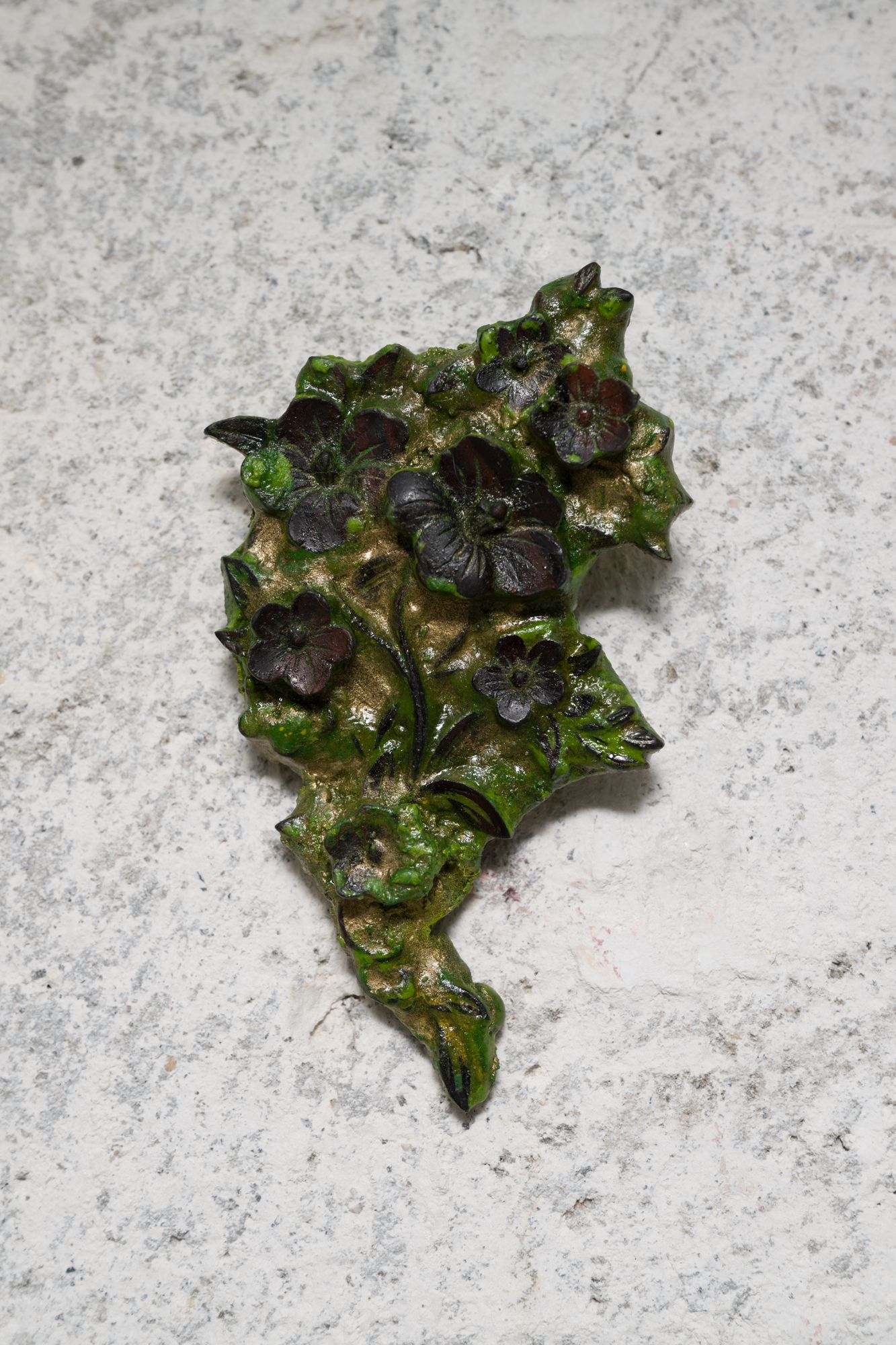
Abandoned Abundance #10
2025
Carved vintage wooden flower, filler,
industrial pigment, spray paint
12 x 7.5 cm
Chan Ting's "Abandoned Abundance" series features secondhand objects sourced from marketplaces or domestic residences. After collecting these objects and their personal stories, the artist transforms them in their studio through a meditative practice of painting, sanding, polishing, and varnishing. In exploring the lost functions of these objects, often abandoned or displaced by previous owners, she examines hyper-capitalist attachments to fixed value and use, and the paradox of an ever-accumulating world that still feels empty.
For Abandoned Abundance #10, Chan Ting sourced carved vintage flowers. In “painting” the flowers with green industrial pigment, a material typically found in hardware stores in Hong Kong, Chan Ting highlights reinvention and reclamation. Once varnished, the lustrous green skin also evokes moss, an ancient organism that subverts conventional ideas of growth and reproduction. Unlike flowering plants, moss thrives without seeds or roots, propagating asexually and adapting to marginal environments in an embodiment of resilience and queer ways of being.
Chan Ting
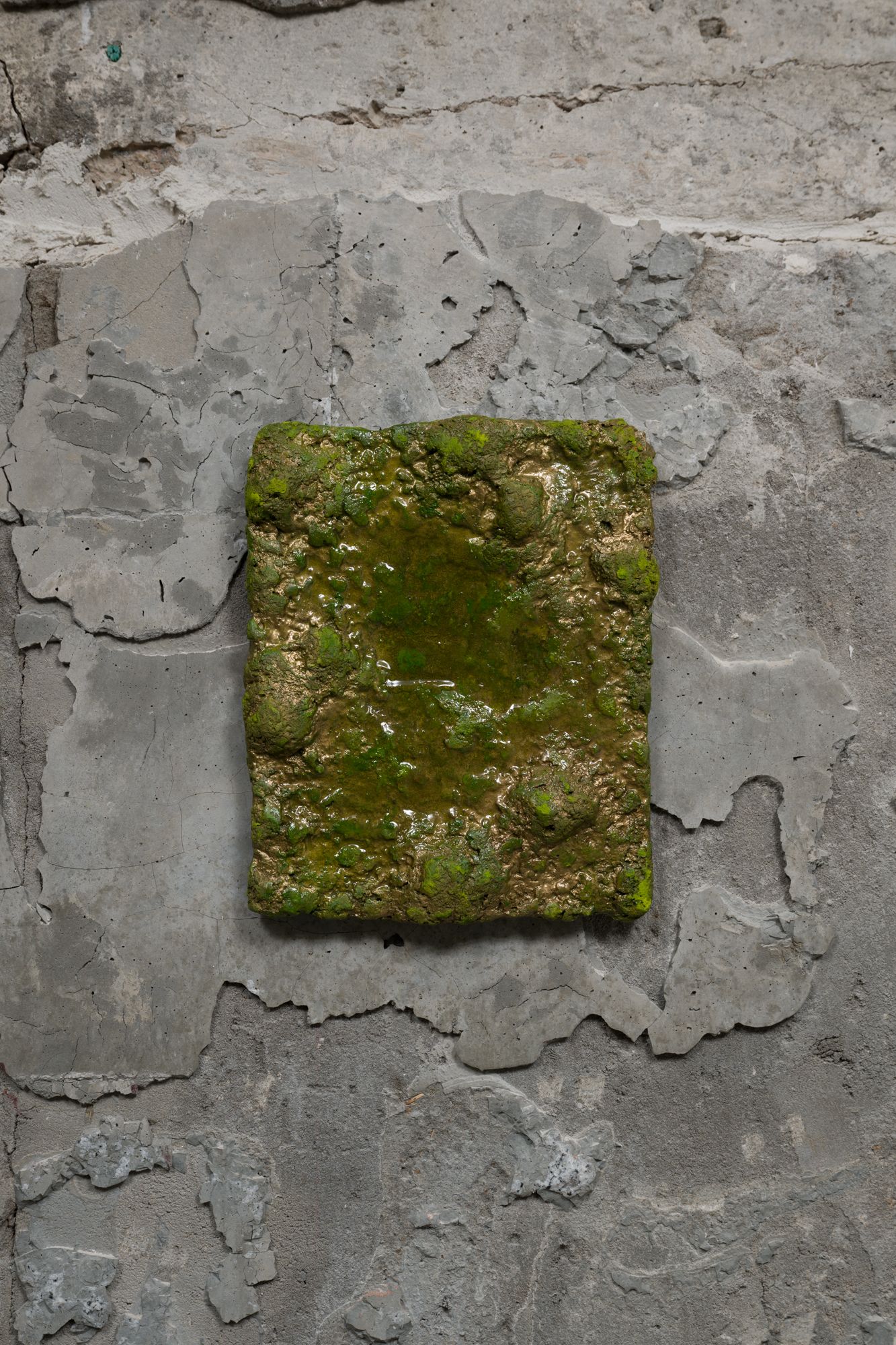
Abandoned Abundance #11
2025
Abandoned frame, filler, mineral colour pigment,
industrial pigment, copper foil, spray paint
26 x 21 cm
For Abandoned Abundance #11, Chan Ting sourced a vintage frame. In “painting” the frame with green industrial pigment, a material typically found in hardware stores in Hong Kong, Chan Ting highlights reinvention and reclamation. Once varnished, the lustrous green skin also evokes moss, an ancient organism that subverts conventional ideas of growth and reproduction. Unlike flowering plants, moss thrives without seeds or roots, propagating asexually and adapting to marginal environments in an embodiment of resilience and queer ways of being.
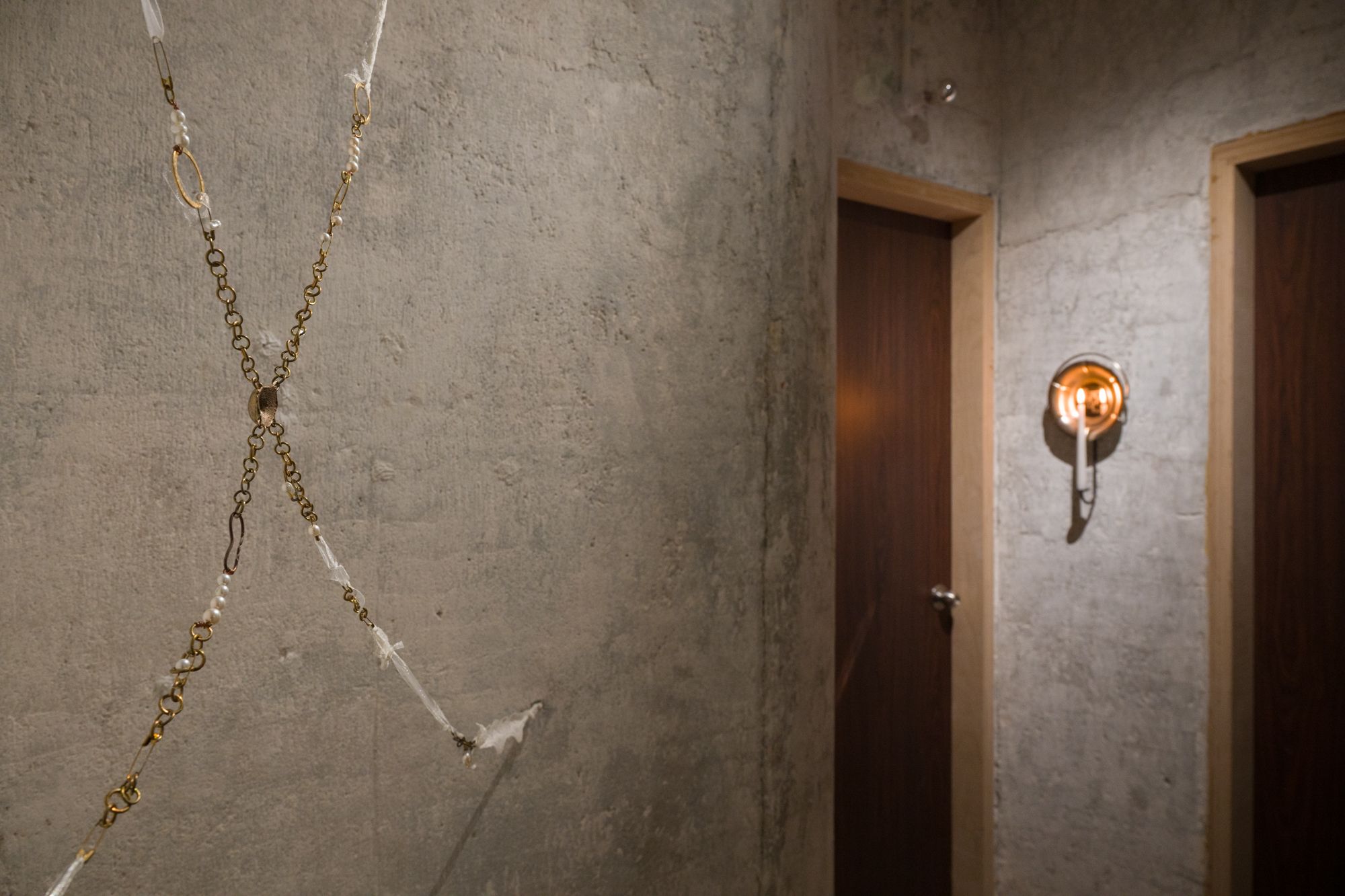
twisting turning belly button chronicles Michele Chu's ongoing meditations on grief, archive, and the body. In this work, a true-to-size bronze cast of the artist’s belly button is at eye-level to the viewer, reminiscent of a child embracing their mother’s belly. Yet the void of the body, traced tenuously via fragile hand-tied ribbons and safety pins, evokes the vanished memory of connection, the only evidence a belly button that once joined mother to child.
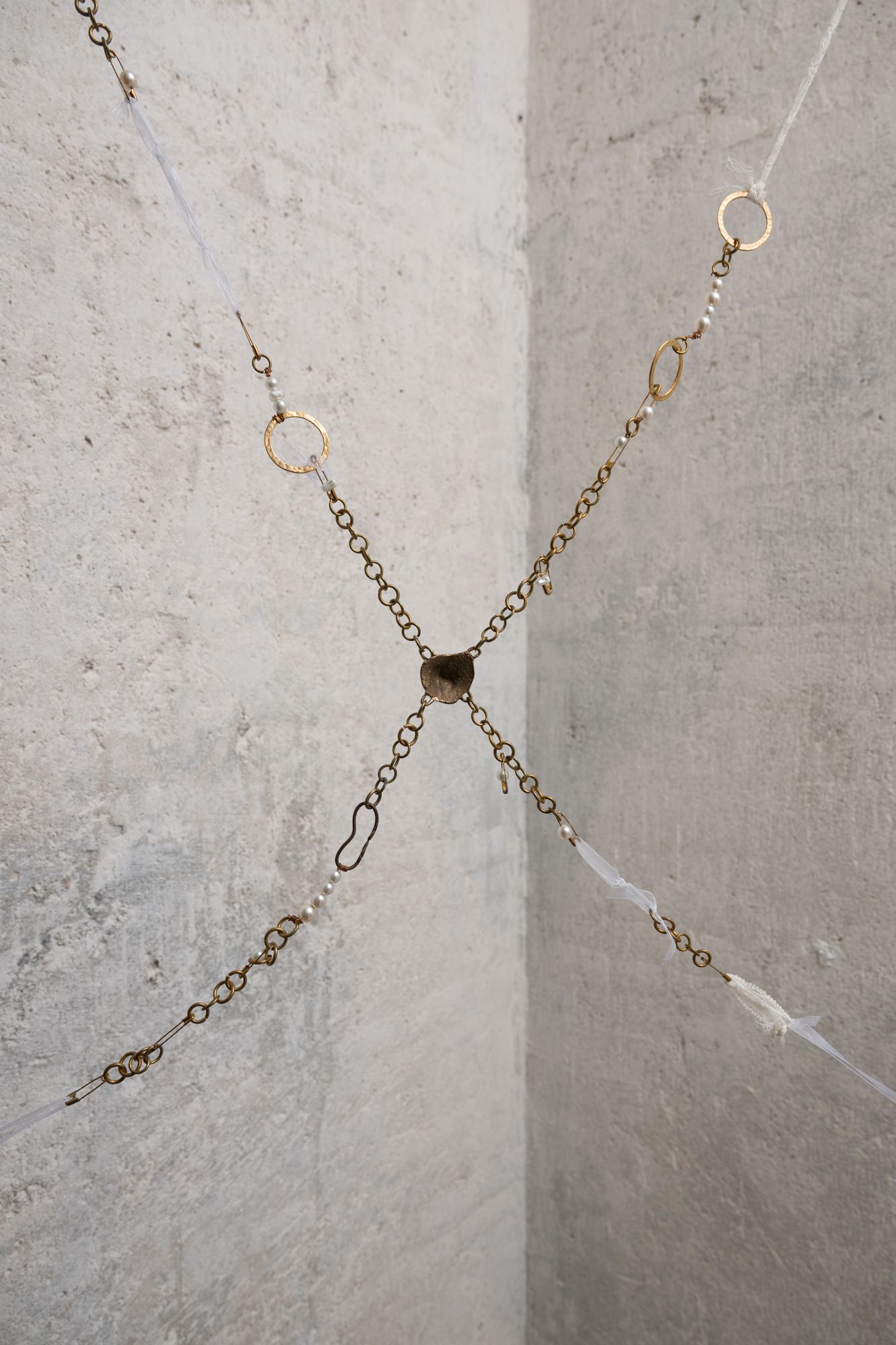
Michele Chu
twisting, turning belly button
2022
Cast bronze, handmade copper
jump rings, lace, ribbon, safety pins,
freshwater pearls, salt
168 x 127 cm
peaches, in july (2025) demonstrates Michele Chu’s investigations into the image as archive, revealing an emulsion lift of the artist’s mother peeling a peach as a tribute to food and nourishment in connection with care. Fused with this image is a fork, stained glass, and solder: a small assemblage of Chu’s continuous examinations of materiality, impermanence, and ritual.
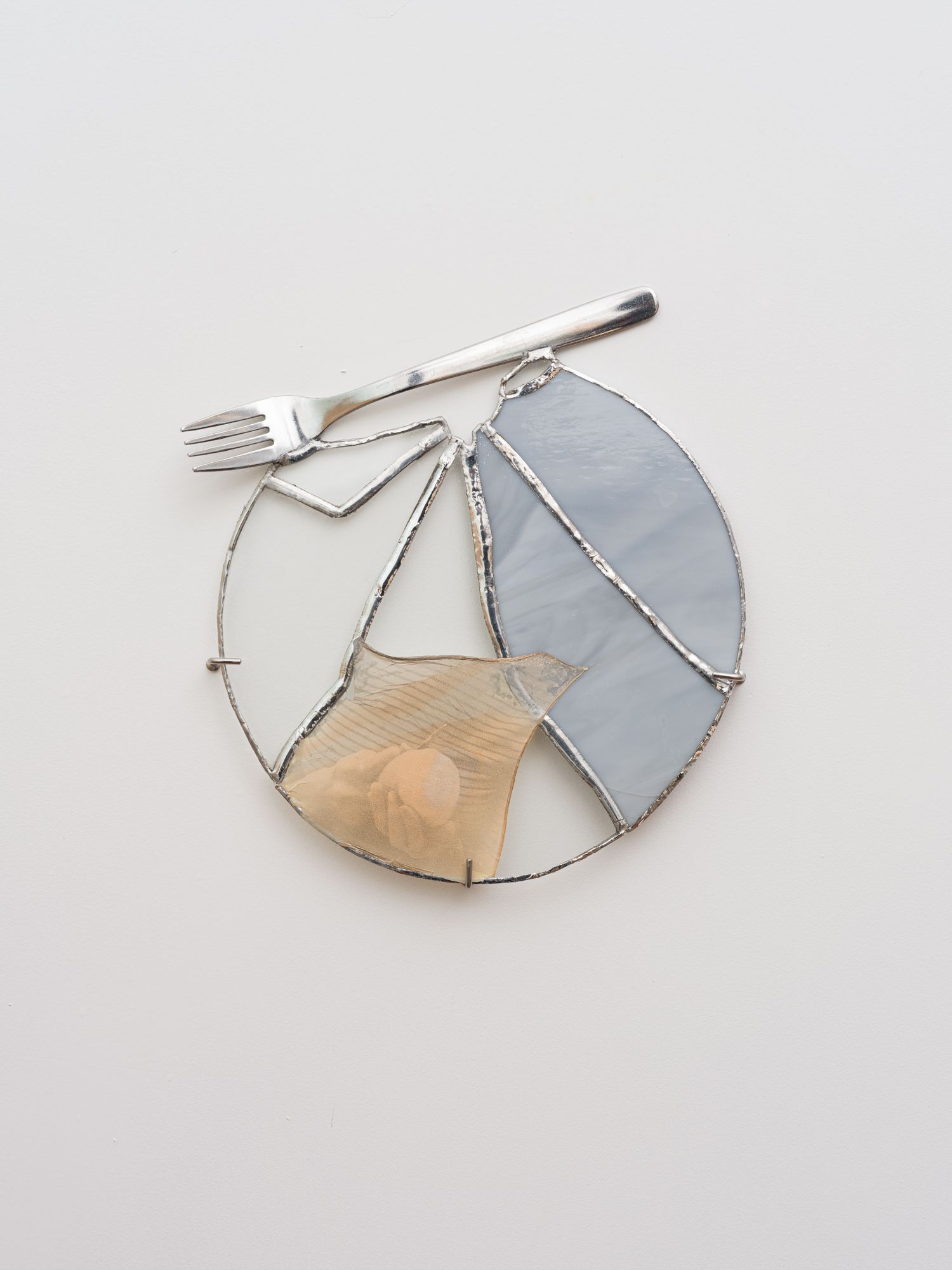
Michele Chu
peaches, in july
2025
Emulsion lift on window glass,
stained glass, fork, solder
23 x 24 x 2.5 cm
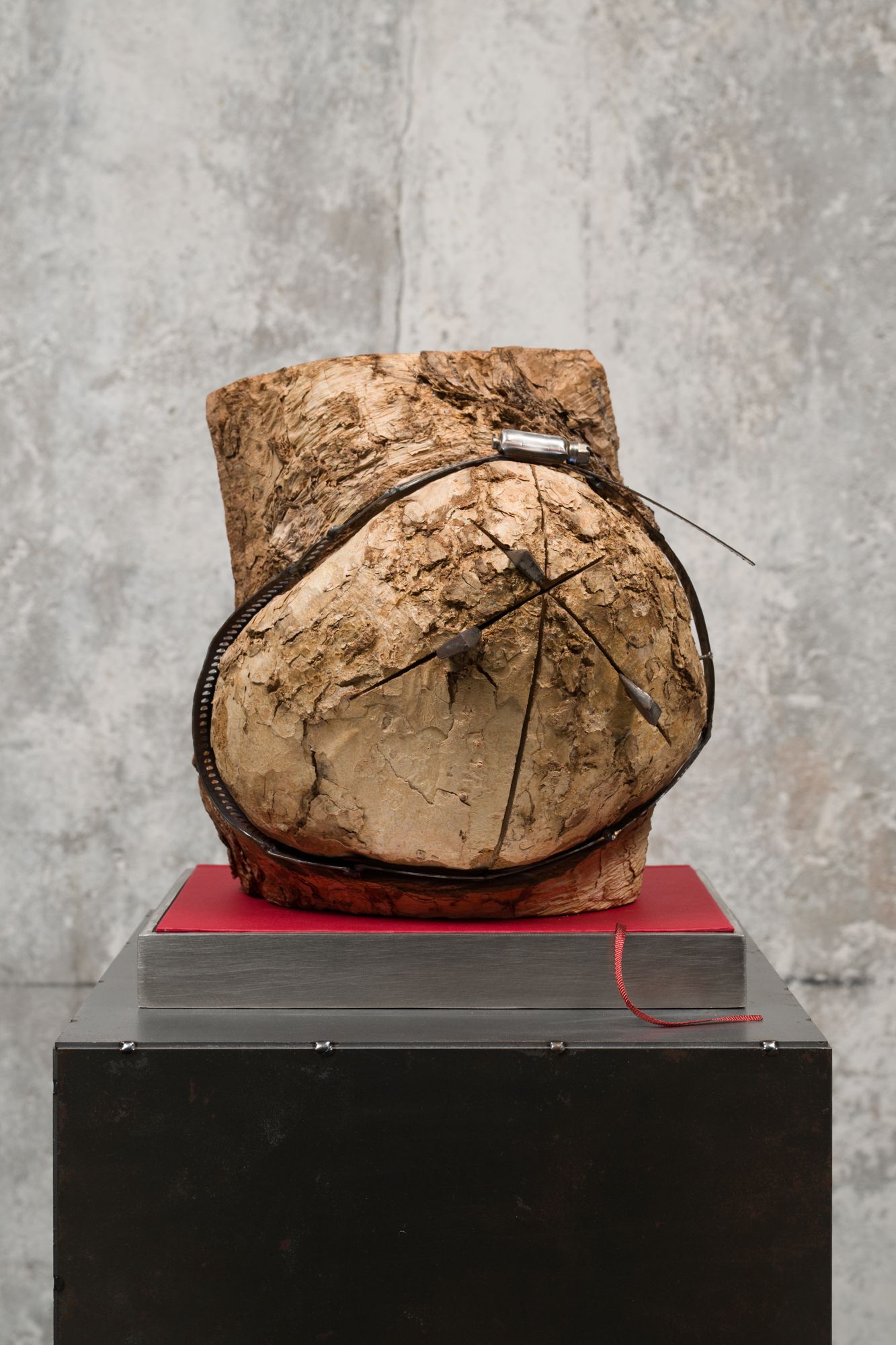
Liao Wen
Bulbous Belly
2025
Maple Burl wood, water hose clamp,
steel wedges, sketchbook, nickel beads,
stainless steel
25 x 23 x 16.5 cm
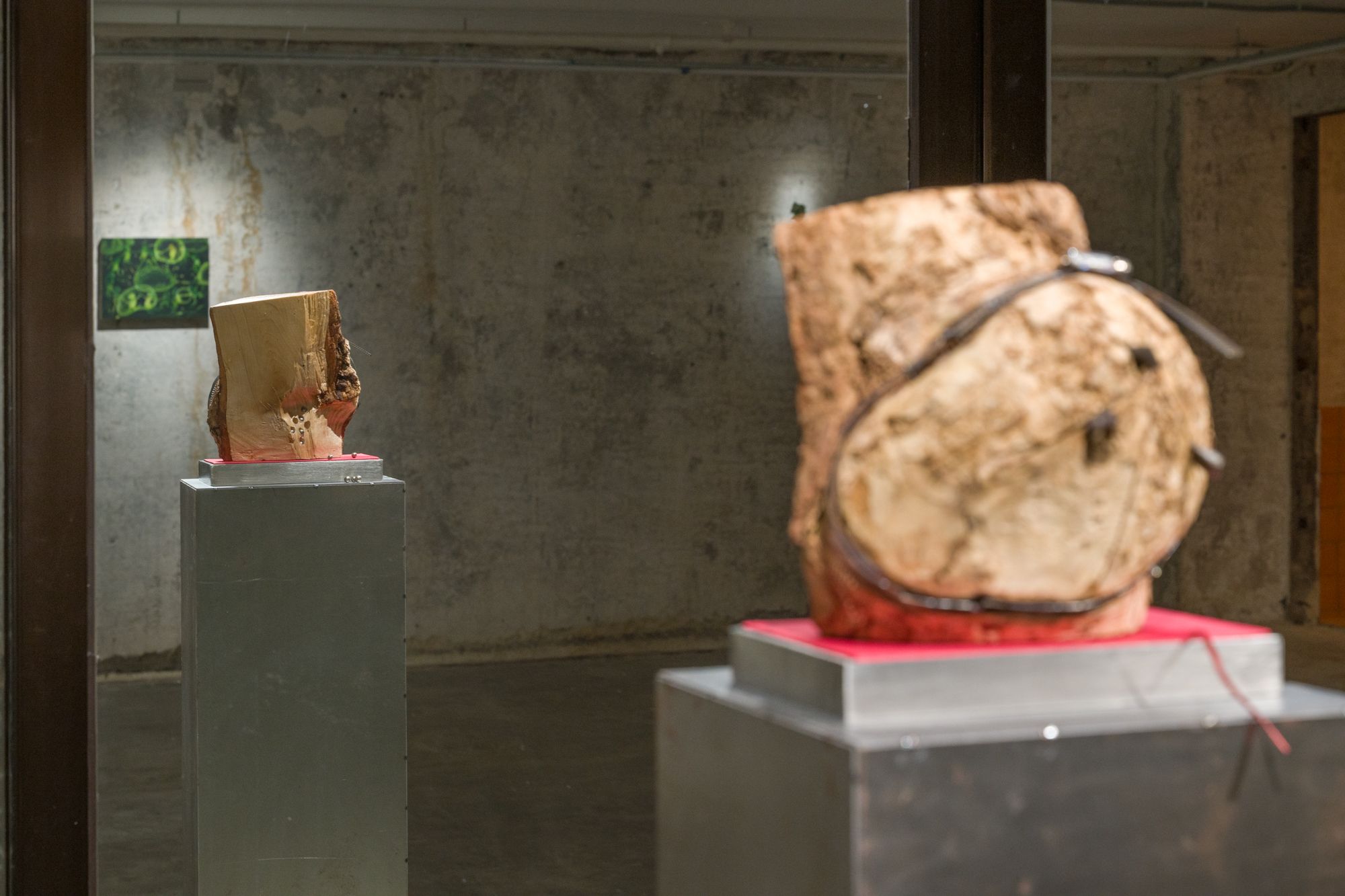
For this new sculpture, Liao Wen examines the changing body in relation to the self. A Maple Burl wood, extracted from a tree trunk, is violently strapped with a water hose clamp, a tool typically used to seal a leak or secure a pipe in place. Yet against the naturally formed and stiff burl, the restrictive device is merely decorative, revealing a desire to repress and bind but the inability to act. A set of steel wedges is driven into the swollen surface, further expressing this frustration; on the backside, small nickel beads are pressed into carved holes, evoking the uncanny feeling that an unfamiliar growth is forming within.
Mirroring the artist’s fear around her own body, in particular the womb — a site that expands and grows, whether with offspring or age — the work narrates how we respond to chaos and disorder, and the powerful truths of our relationships with ourselves. A small red sketchbook, placed underneath the wood burl, invites the work’s future owner to fill its pages.
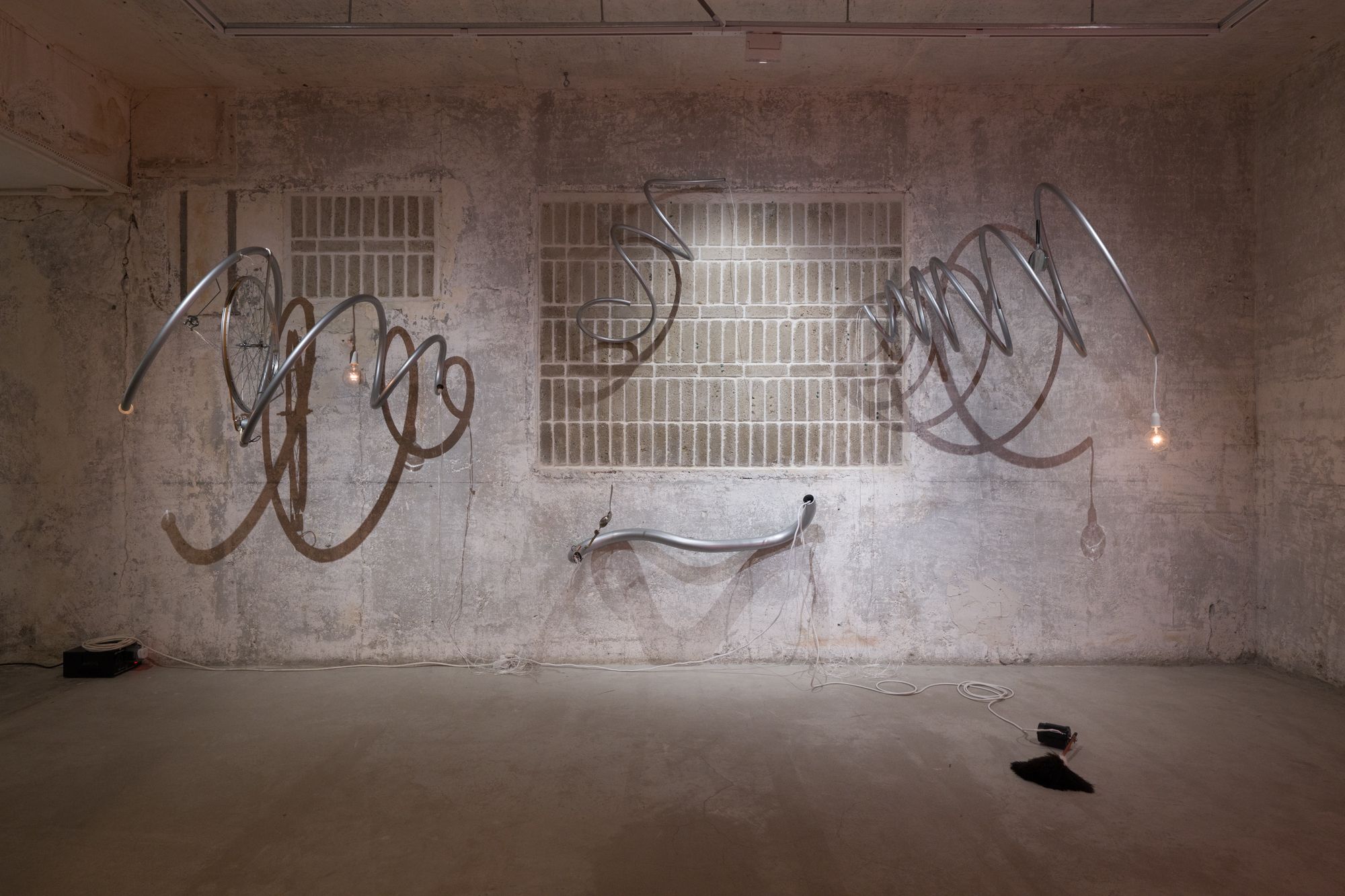
Yuko Mohri
Copula
2021
Iron, cable, motor, spoon, magnet,
bicycle wheel, light bulb, feather duster
240 x 437 x 88 cm
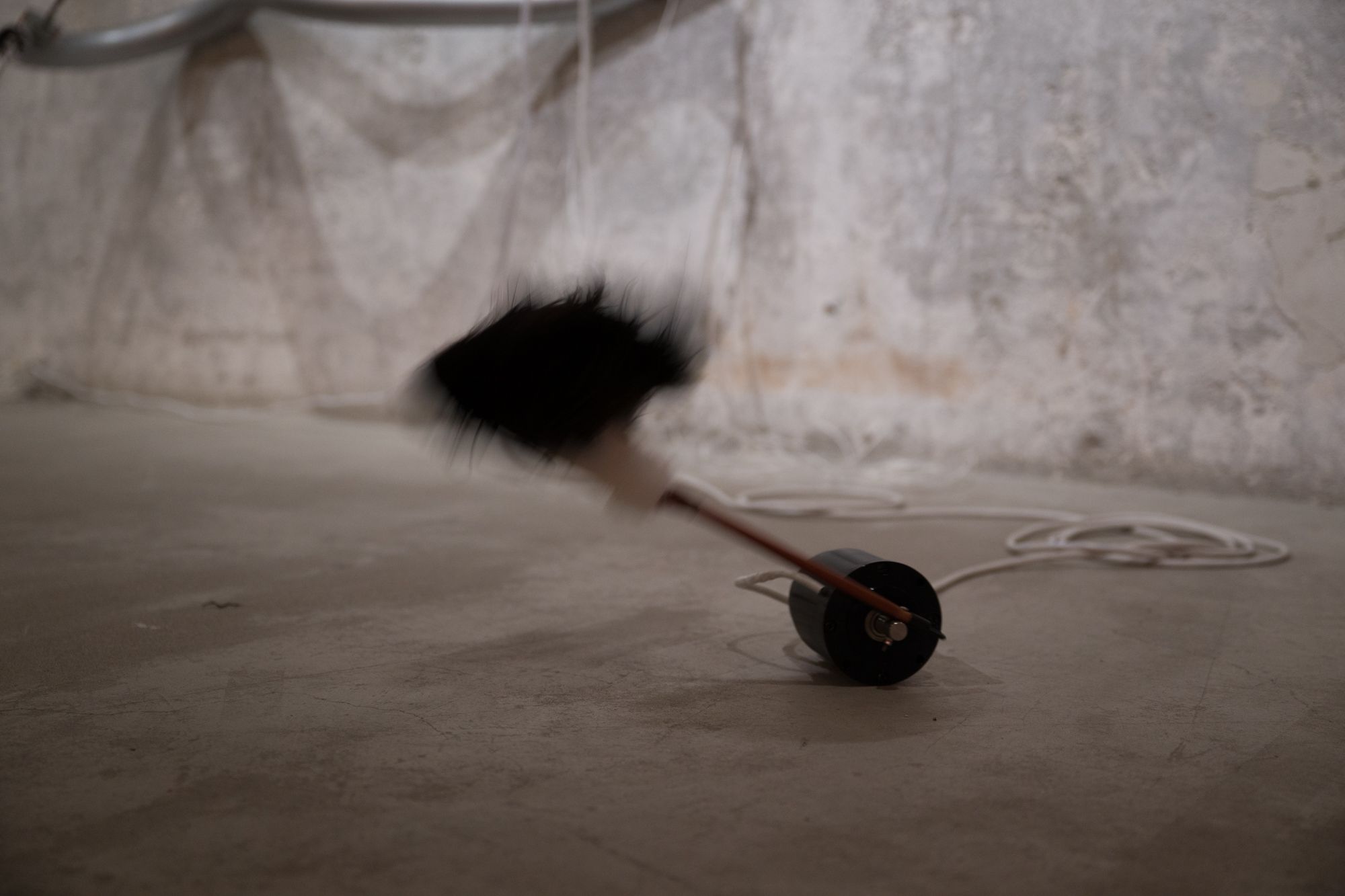
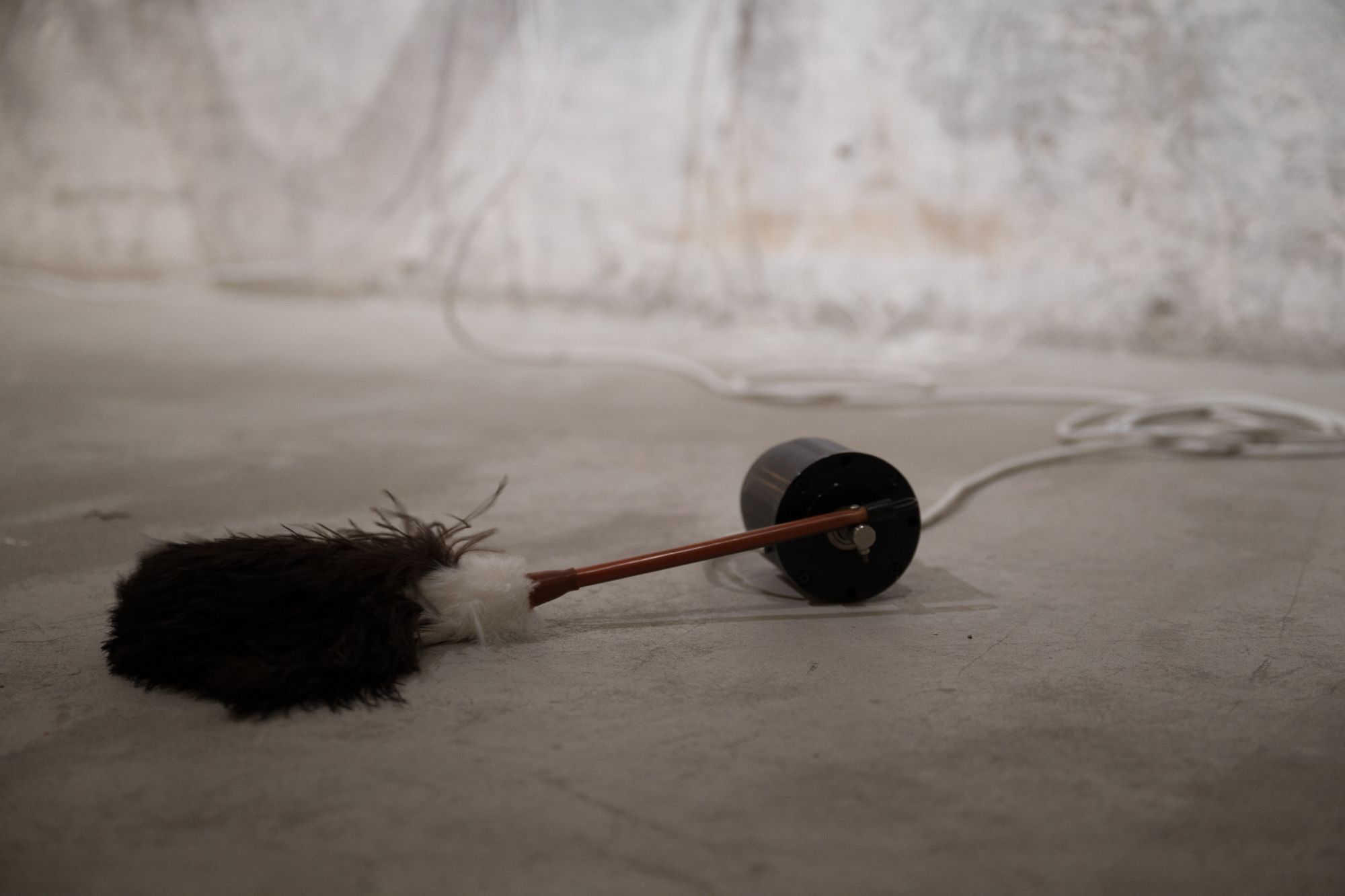
Based on the Latin term copula, meaning “connection,” this installation incorporates a wide range of elements linked by invisible forces. Two spoons in the center of the piece touch, which causes a lamp to flicker, a wheel to turn, and a feather duster to thump. The configuration of pipes recalls various forms of energy and eternity as they relate to vortexes or helixes. By visualizing these relationships, Yuko Mohri provides us with new realizations, and encourages us to take notice of various relationships in the world in which we live.
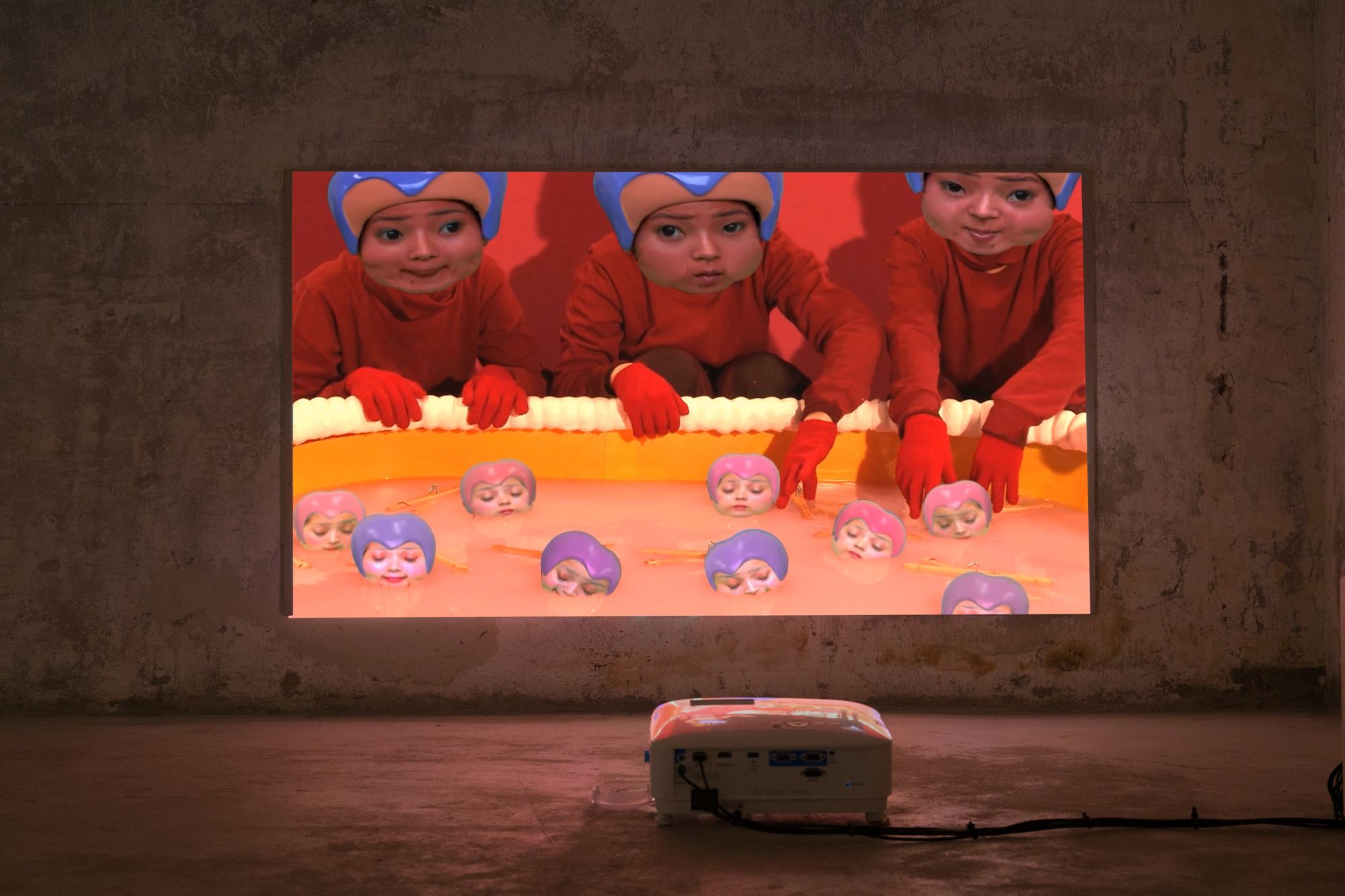
Sasaoka Yuriko
Atem
2014-15
Single-channel video with color
and sound: 4 min 2 sec
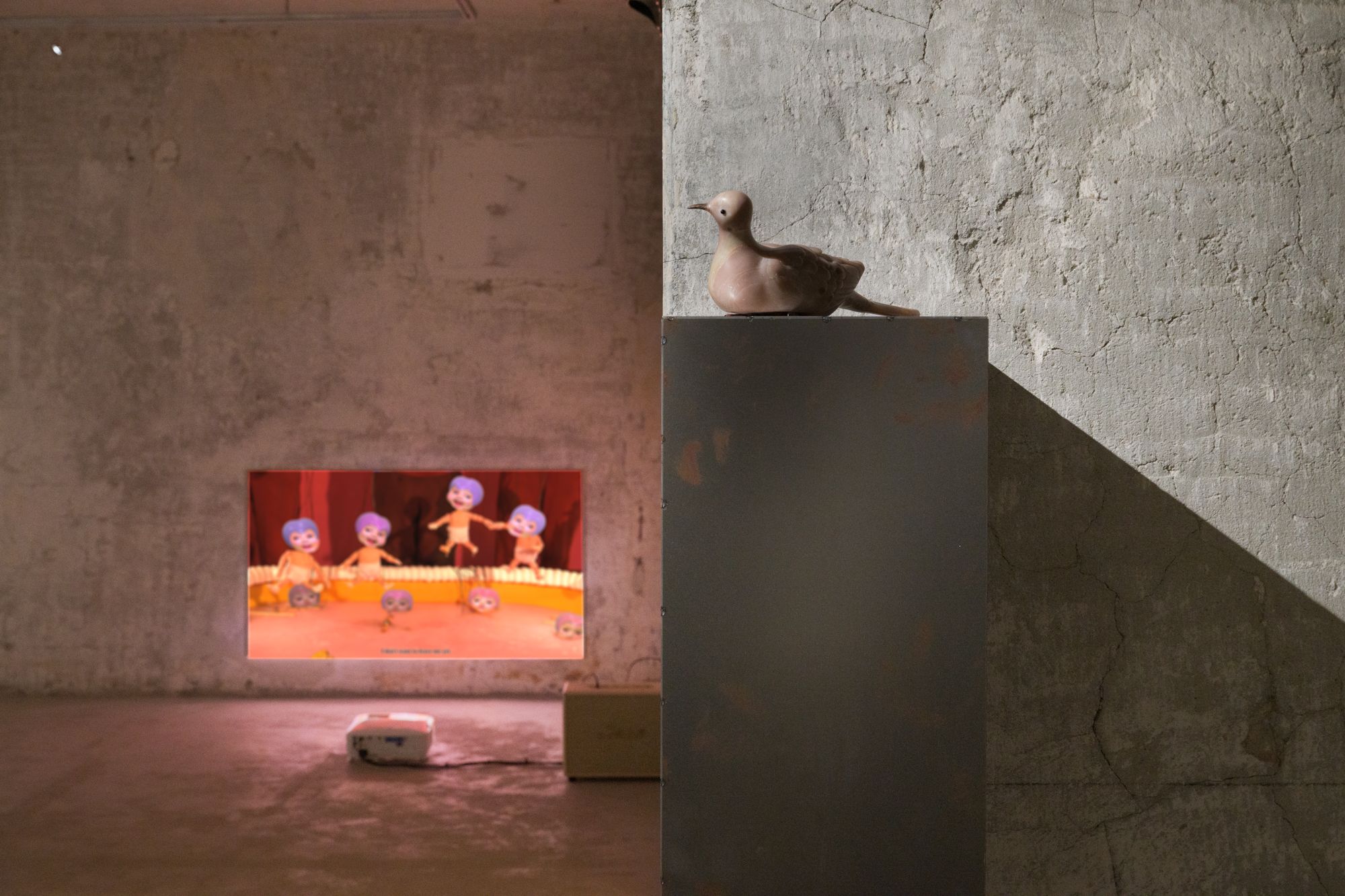
Atem (2014-15) is a short, early video by Sasaoka Yuriko that explores the melancholic process of growing up. A collective of pink and purple-haired baby dolls splash around in a large inflatable pool, puppeteered by three red-clothed figures above. As the babies sing, the video occasionally glitches, their hair changing styles and colors — a metaphor for how identity is formed and fixed as we grow older. Vignettes of childhood and young adulthood are performed by these babies, reminiscent of children playing make-believe, yet a sense of unease is expressed in the eerie grins of the characters.
Featuring various identities of the artist — whose facial expressions are captured and then superimposed onto the puppets — the work is an early example of Sasaoka’s interrogations into social conformity and identity, illuminated by her use of puppets and puppeteers as a metaphor for agency and control.
Souvenir – Incense Altar (2025) presents a space of quiet remembrance at an intimate, domestic scale. Referencing the practice of sealing cherished images and objects beneath glass tabletops — a common practice in domestic settings — Tan Jing prints onto fabric documents and epistolary fragments from family archives. Examining in particular the long separation period between her late Thai-Chinese grandparents and their relatives in Thailand from the 1960s up to the 1980s — the result of rising social and political tensions between the two countries at the time — the artist includes intimate, handwritten notes and official immigration paperwork, hinting at the painful duality of private and public life, family and politics.
Layered over the printed surfaces are pressed incense petals crafted by the artist. Their formula draws on the scents often encountered in Thai temples during her field research. As the petal-shaped incense burns, faint aromas and traces of melancholy drift through the space, an act of mourning for those who experienced double displacement under specific historical circumstances, and a quiet release for what was lost or never fulfilled.
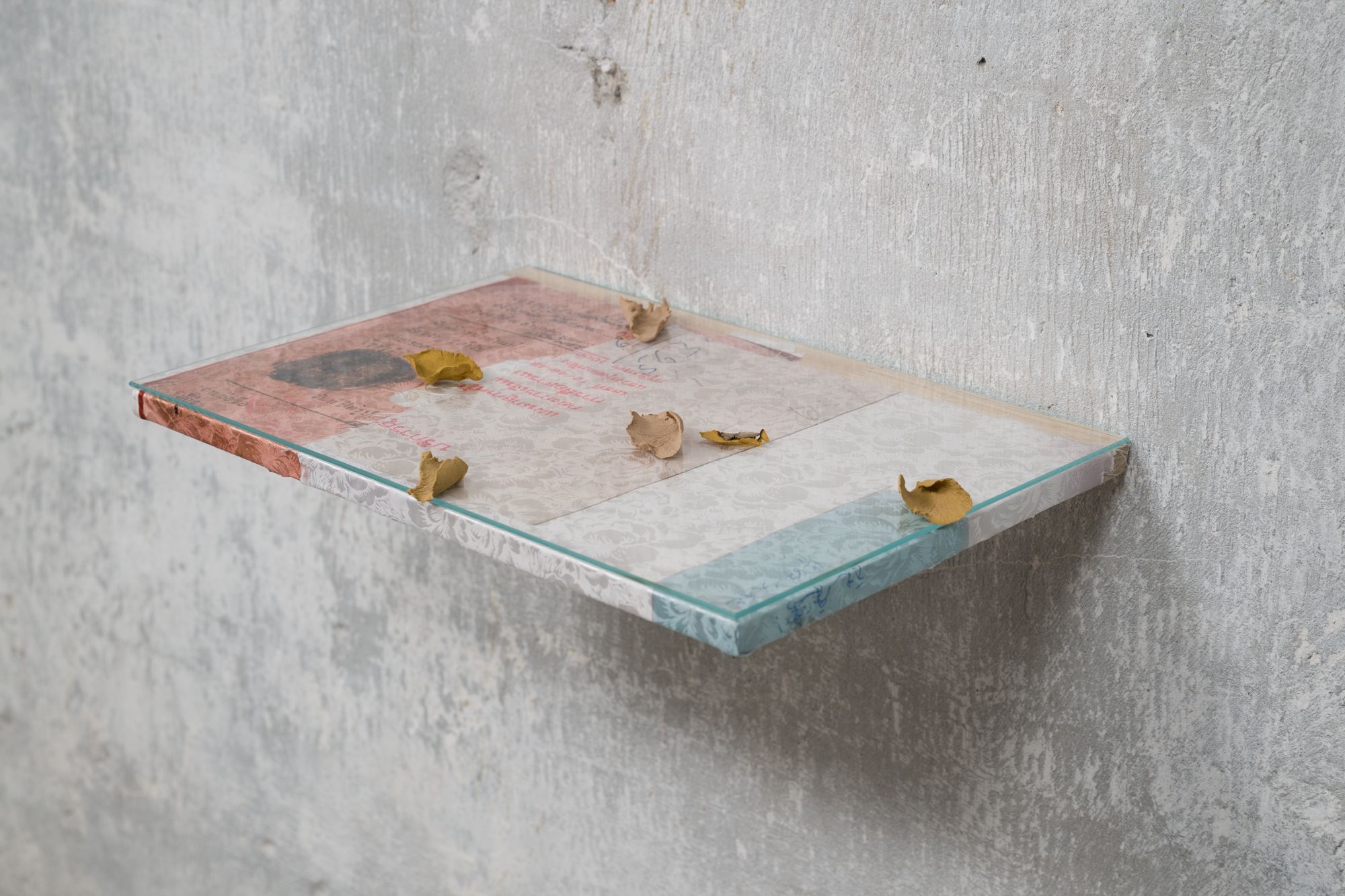
Tan Jing
Souvenir – Incense Altar
2025
Archival images and letters printed on fabric,
cedarwood, agarwood, clove, benzoin, lemongrass oil
petals, glass, pine wood
27 x 40 x 2 cm
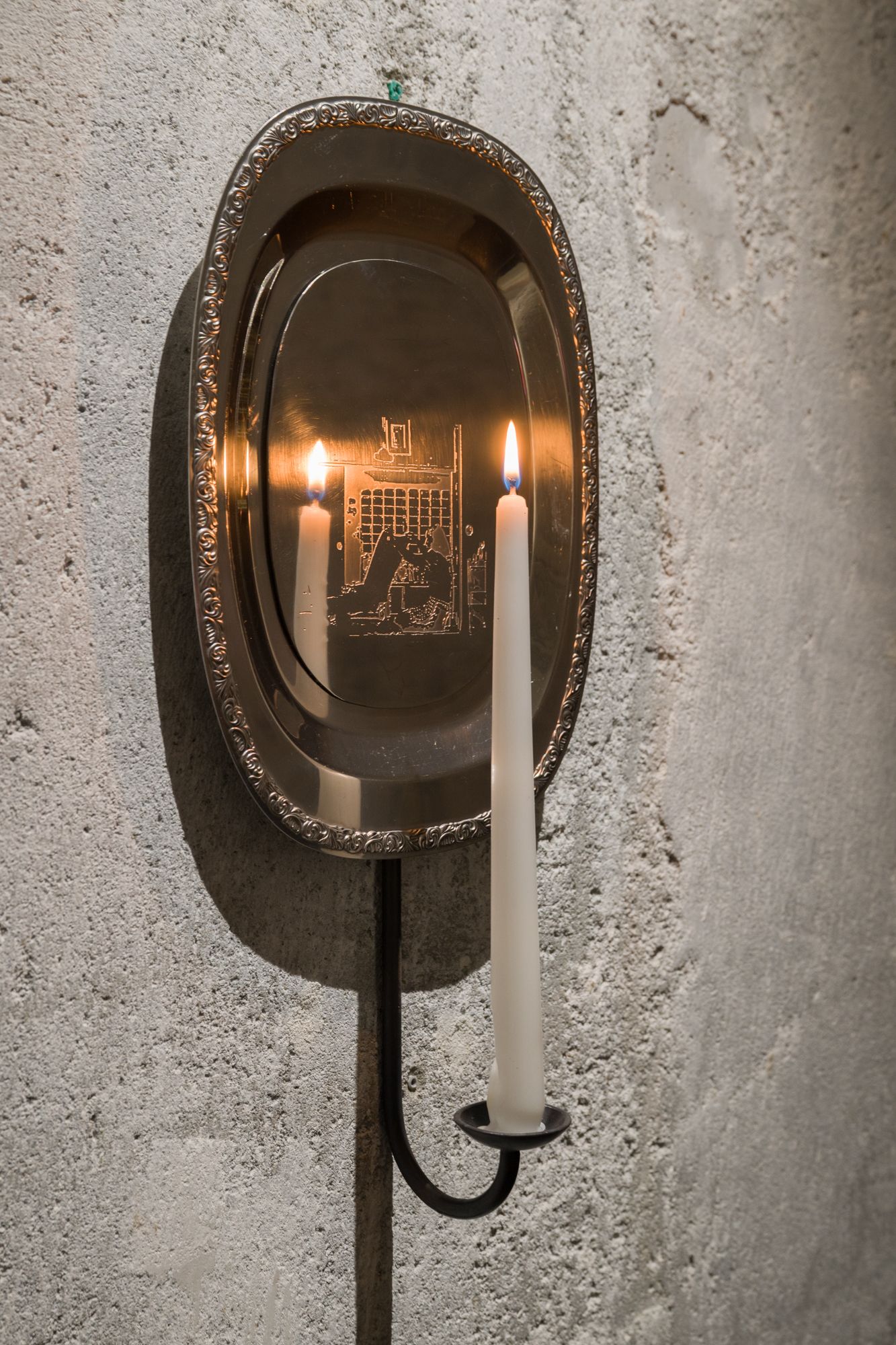
Pam Virada
Noriko in Late Spring
2024
Acid etching on stainless steel, found tray,
metal, candle
22.2 x 44 x 10 cm
In her multidisciplinary practice, Virada creates objects, moving images, and installations that reference the cinematic and the spectral.
For these works, Virada etches onto serving platters stills from the films of Japanese director Yasujiro Ozu (1903 - 1963). Virada focuses on Ozu’s female characters, in particular the daughters Noriko and Ayako. The formal quality of the serving platters, now repurposed as sconces for candles, evokes the gendered expectations of female characters in domestic spaces. The quiet scenes, barely visible on the silvered surfaces, reveal subtle tensions and a longing for agency against a conservative Japan still struggling to modernize.
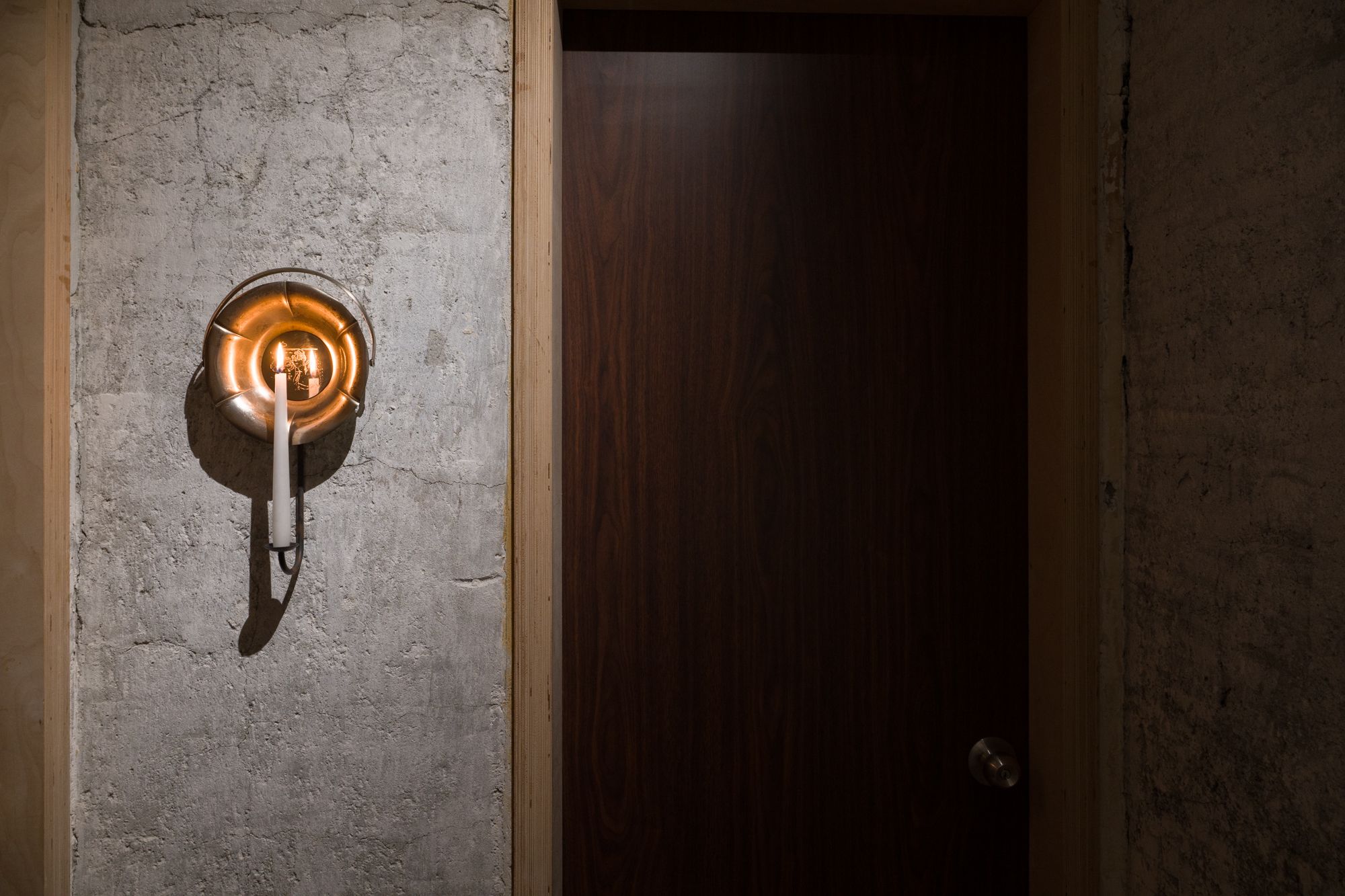
Installation view of Pam Virada's "Ayako in Late Autumn," PHD Group, Hong Kong, 2025.
Carved out of Himalayan pink stone, Day and Night is a sculptural tribute to a mourning dove that lived on top of an exterior air conditioning unit in Wang Xu’s old apartment in Chinatown, Manhattan. Over four years, the bird gave birth to many broods, witnessed by the artist from a narrow window in his small apartment; a shared intimacy was experienced, particularly poignant during a time when the artist had just moved to New York from China. During the pandemic, the artist lost the apartment when he travelled back home to China and was quarantined there — as he was unable to say goodbye to the mourning dove, he created an homage to her here, inviting visitors to touch her and provide her with their warmth, just as she once provided warmth for him.
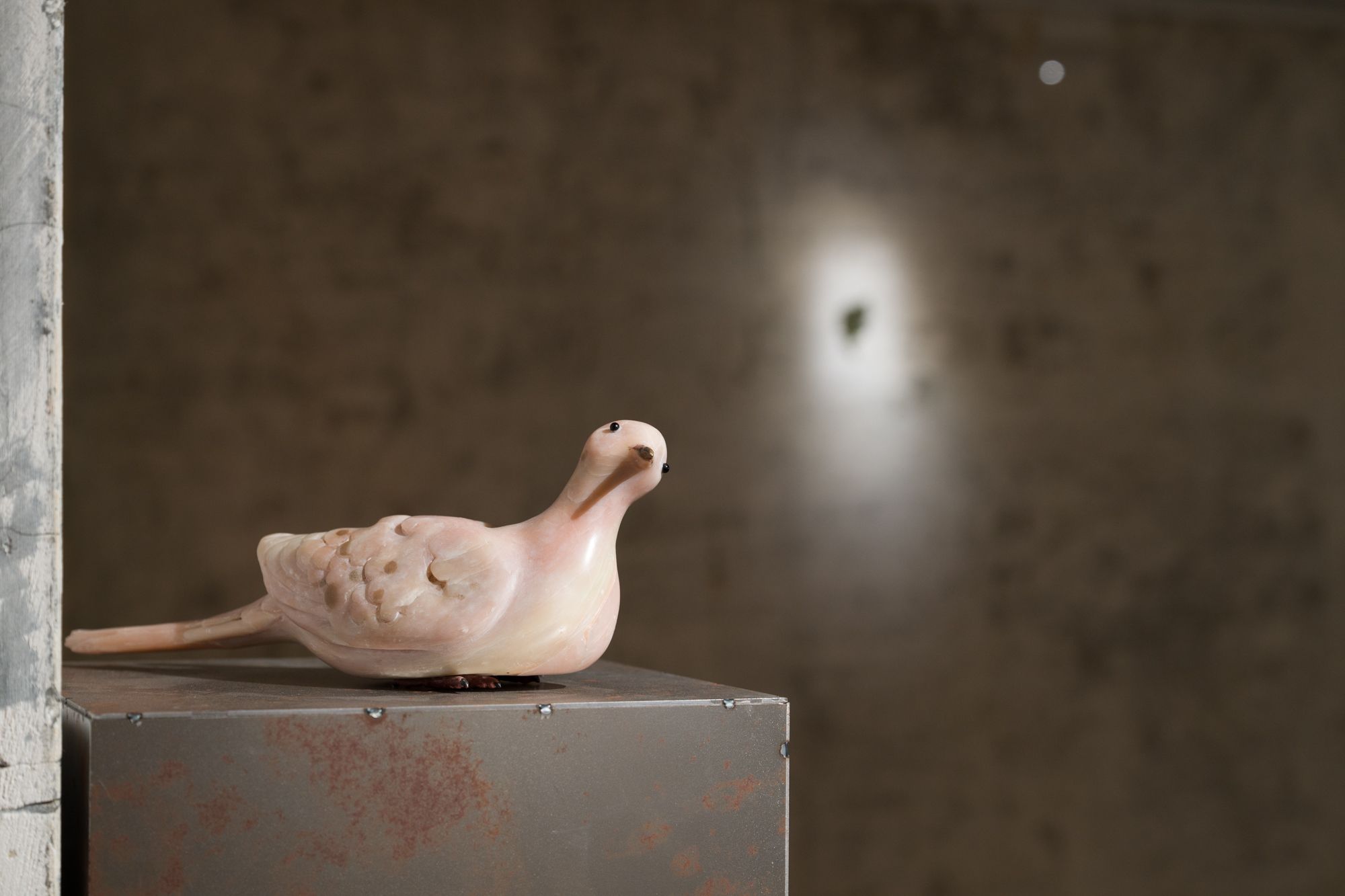
Wang Xu
Day and Night
2025
Himalayan pink stone, red pipe stone,
glass, steel, watercolor
10.5 x 30 x 7.5 cm
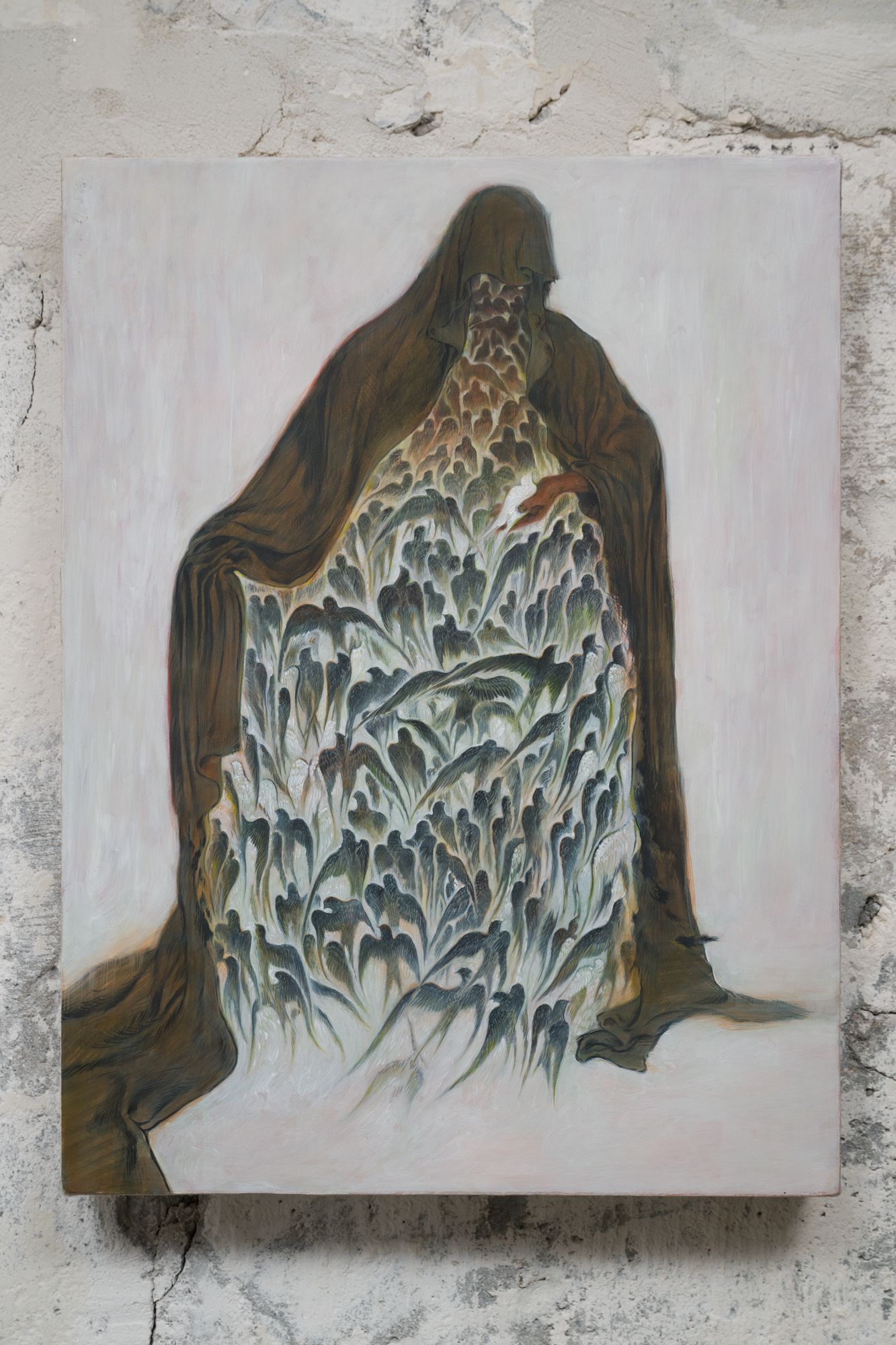
Xi Jiu
The Sanctuary
2025
Oil on linen
40 x 30 cm
The Sanctuary by Xi Jiu takes inspiration from a short story by French author Marguerite Yourcenar. In it, a priest becomes convinced that pagan nymphs are living in a cave nearby, and blocks the entrance. Yet a reveal at the end shows that the nymphs are in fact living swallows, now trapped within the cave.
Xi Jiu’s painting expands this narrative to depict the flock of swallows, sheltered by a cloaked figure that resembles the Virgin Mary. While it is unclear whether the figure intends to protect or trap the birds, the bright and overlapping forms of the flock suggest a mysterious, regenerative force.
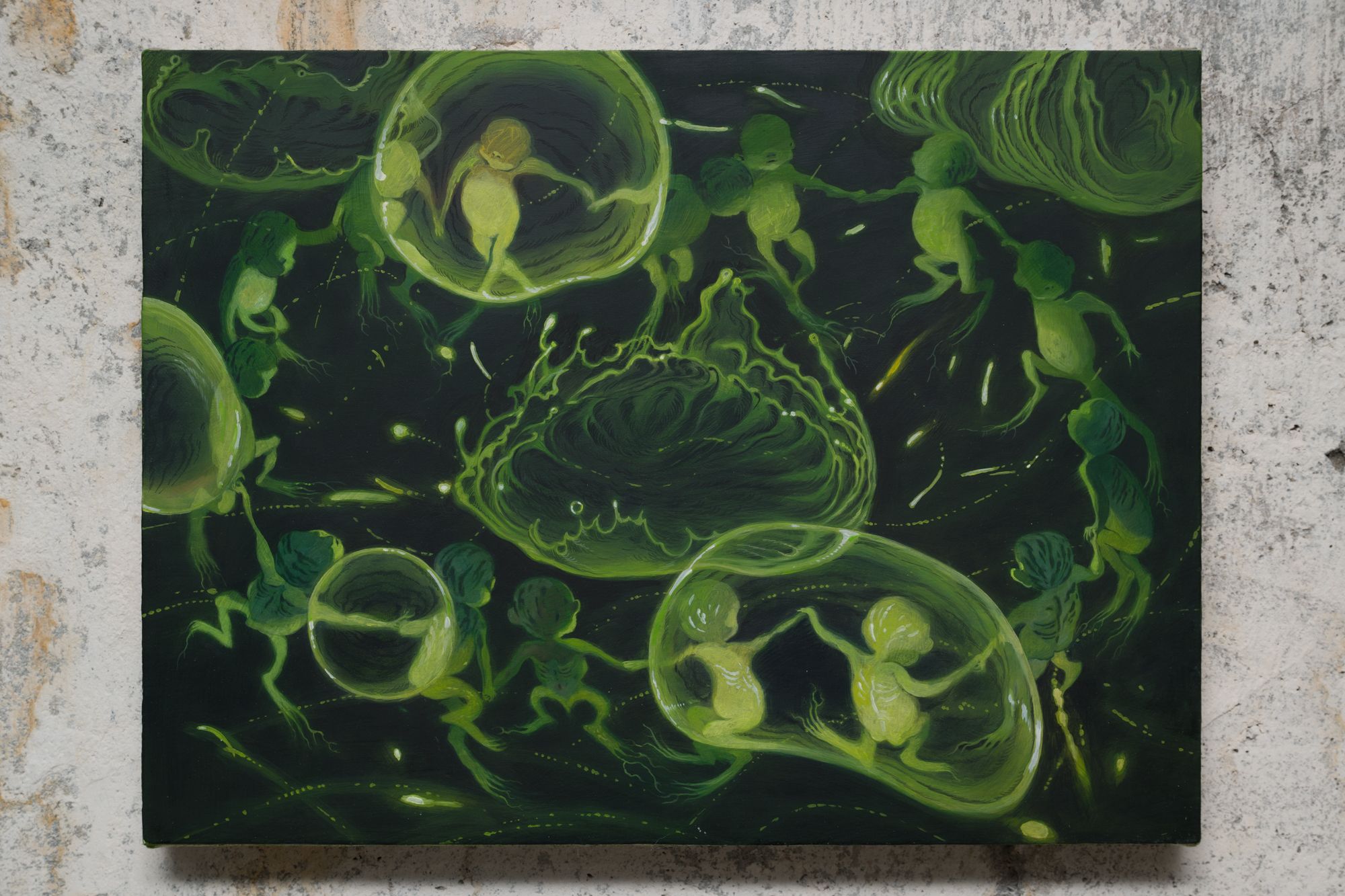
Xi Jiu
Dance of Raindrops
2025
Oil on linen
30 x 40 cm
Dance of Raindrops by Xi Jiu depicts lively forms, directly inspired by the plants found on the rooftop of PHD Group. Named mother of thousands, the plants propagate vegetatively by forming tiny plantlets on the margins of each leaf, potentially birthing hundreds of offspring.
These drawings by Zheng Mahler illustrates just two of the almost infinite species of mushrooms found on Lantau Island, where the artists currently live and work. The work comprises the initial research phase of a forthcoming multi-part project around the artists’ field research documenting fungi in order to create a dataset used to train a custom generative AI model. With this project, Zheng Mahler asks the question, “How does a mushroom sense?” and seeks to give the audience a glimpse of how a mushroom might experience the world.
The project will unfold in 2026 with a M+ commission titled “The Twenty-Three Thousand Genders of Schizophyllum Commune and Other Stories,” followed by a solo exhibition at PHD Group, “Mushroom Clouds.”
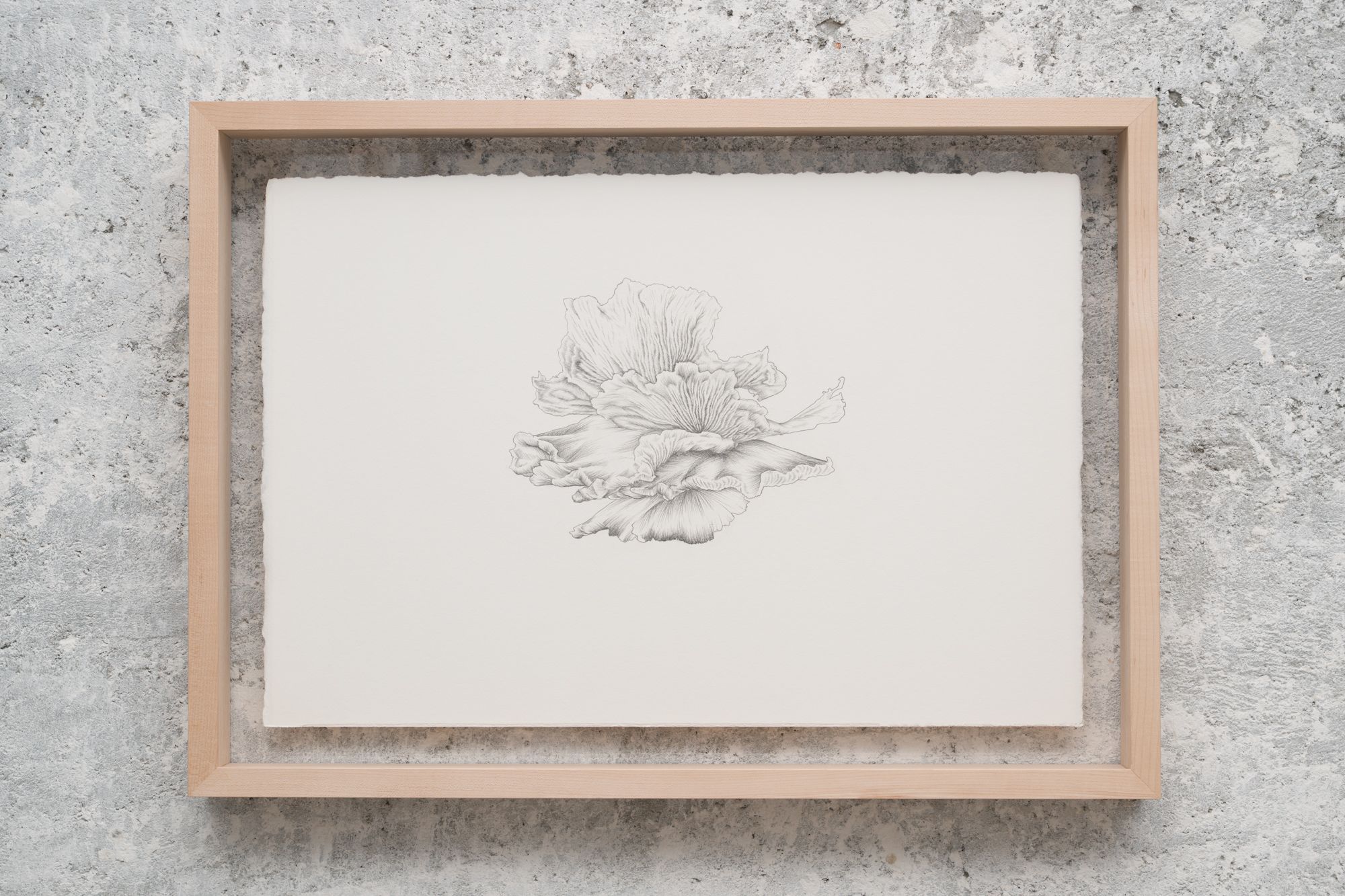
Zheng Mahler
Pleurotus Ostreatus (Oyster Mushroom)
2025
Graphite on watercolor paper
29.7 x 42 cm; 48 x 66.5 x 6 cm (with frame)
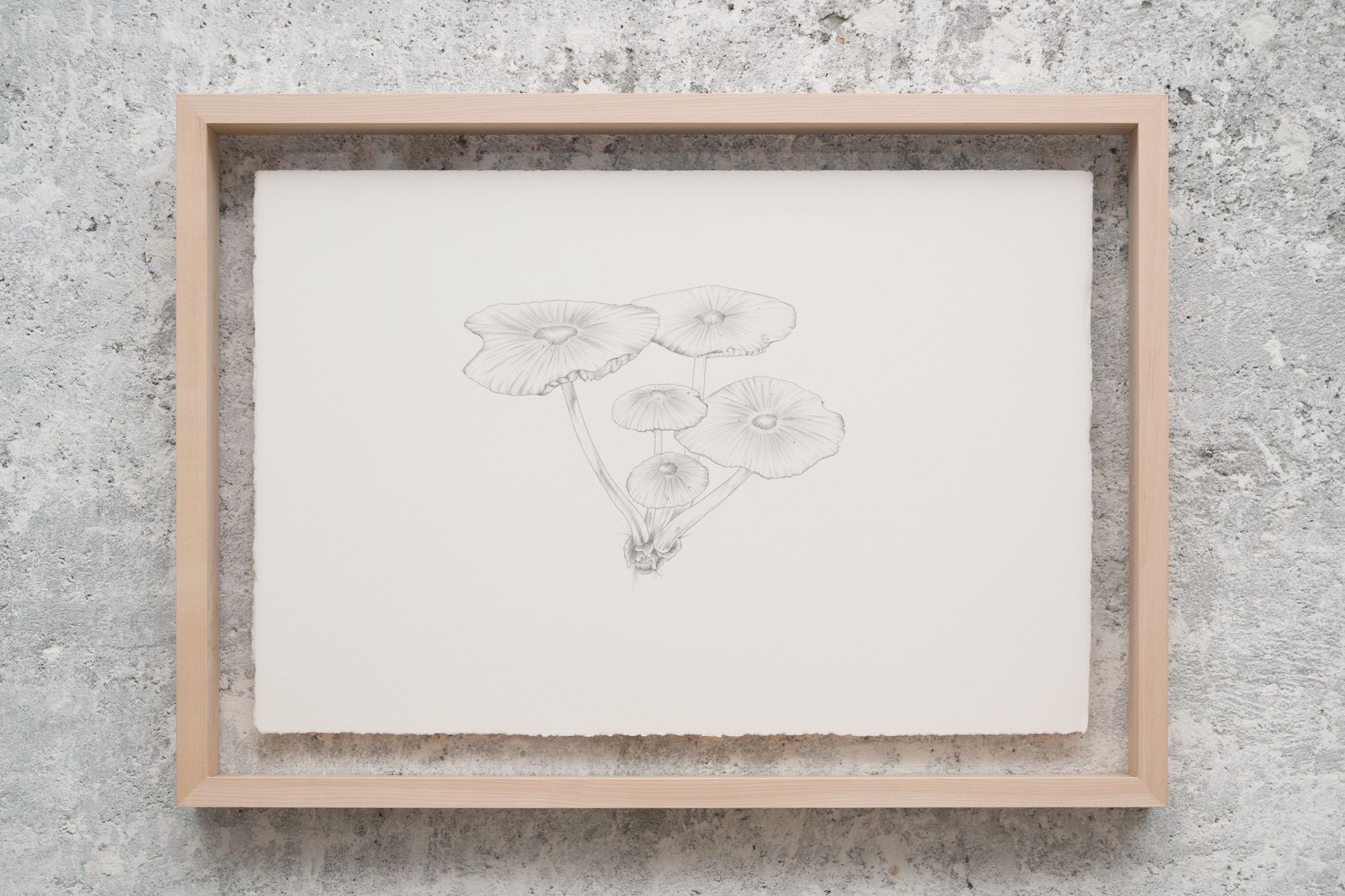
Zheng Mahler
Amanita Farinosa
2025
Graphite on watercolor paper
29.7 x 42 cm; 48 x 66.5 x 6 cm (with frame)